This is a followup to the Modern Reharmonization blog post about using the chord reharmonization charts. Hang on to your seat this gets a bit deep 🙂
The first thing to realize is that a chord reharmonization chart like the one you see below is great for seeing other places to apply a C Major Pentatonic Scale, or to harmonize one of the notes of the scale with the listed chords. Keep in mind that is only one of many ways to reharmonize.
Think of the above chart as reharmonization based on chord tones and tensions. You can learn to use this concept by working with the Chord Workbook for Guitar Volume Two or the New York Guitar Method Volume Two and Ensemble Book Combination These two books give you examples of chord progressions that use reharmonization with chord tones and available tensions.
You don’t need to be a guitarist to use these books to study this type of chord reharmonization.
Next we have harmonic reharmonization. This is where you use the 3 ways that a dominant chord can resolve, plus a few other concepts to reharmonize a chord progression. Chord Workbook for Guitar Volume One, New York Guitar Method Volume One and Ensemble Book show you 36 chord progressions and the voicings to use to make them sound great. You will also find that the Harmonic Analysis course will teach you how to see these harmonic reharmonization situations quickly, which is important if you are going to reharmonize on the spot, which is what most great guitarists and pianists do. Also any great improvisor is constantly reharmonizing through their melodies as they play so they know these concepts thoroughly too.
There is one more concept that I don’t have a book for — hard to believe 🙂 — and that is single note reharmonization where you take a note like “G” and find every chord that could contain a “G.” Below is a list of 7th chords that contain a “G” or to which a “G” could be added to their structure. The list would obviously be larger if we looked at every chord in every key with all possible tensions added:
B: 7b5, 7, 7sus4, 7#5, 7#11, -7b5, 7b13, Major7#5, °7
There are of of course other non-traditional chord structures that could contain a “G.” “The Sonic Resource Guide” is a good source for finding these chords.
Then we have pitch class set reharmonization which is simply changing the notes you use to form a non-traditional chord and then using the concepts presented above. “Sonic Resource Guide” and the Ultimate Three Note Lexicon books are great for seeing and using this concept. The Essential Scales book looks at an important subset of these chords based on 22 scales.
So you can see that the world of chord reharmonization is BIG. Add to this the two crucial considerations of voicing chords and voice leading when working with any of the concepts presented above; that is why the following books are so important:
Chord Workbook for Guitar Volume One Chord Workbook for Guitar Volume Two New York Guitar Method Series
These books show you how to voice these structures and how to use them in chord progressions to bring out their beauty. I should also mention that you can apply any of these chord concepts to pitch class sets and much of that info and examples are found in the Ultimate Three Note Chord Lexicon books.
Just for clarity: you could also have chords formed from counterpoint, constant structure, modal interchange, approach chords and intervallic structures. There are passing references to this in some of my books but a yet I have not put out a complete method. (But stay tuned!)
Check out other Bruce Arnold blog entries on brucearnold.com here
You might enjoy checking out the “Music Education Genealogy Chart” located on my artist’s site. You will clearly see the historic progression of pedagogy that is the basis for Muse Eek Publishing Products. Great musicians throughout history have been studying the ideas presented by Muse-eek.com which derives its content from a a lineage that stretches back to Scarlatti!
Modern Reharmonization can be a somewhat complicated subject and it can be approached from many angles. In this blog post I want to show how some of the charts found in my books can be used to reharmonize a song, but also how this information can be used to get more use out of the things your already know or learn in the future.
List of Bruce Arnold Books Containing Reharmonization Charts
The books below contain the reharmonization charts discussed in this blog post:
“Sonic Resource Guide” has a complete listing of every possible scale and its application to every chord type.
“Essential Scales” shows you how to apply 22 of the most used scales to different chords in 12 keys.
“Scale Analysis” shows you which scales work within a complex chord progression, the likelihood that they will show up and how to hear each scale so that you can develop your ear training skills.
“Ultimate Arpeggio” takes a look at every three note chord combination. (There are only 12 possible three note chords) It then shows you the application of every three note chord through charts and also real musical examples via études.
“Ultimate Three Note Chord Lexicon” takes an in depth look at each of the twelve three note combinations with études. It also includes a list of all possible chords and which of those chords can be easily played on the guitar.
“Trichord Sweep Pairs” shows you which chords in every key will sound good with each three note combination.
“Tertial Octatonics” shows you how you can combine two “7th chords’ into an octatonic scale and every chord that these combinations work over.
Modern Reharmonization Chart
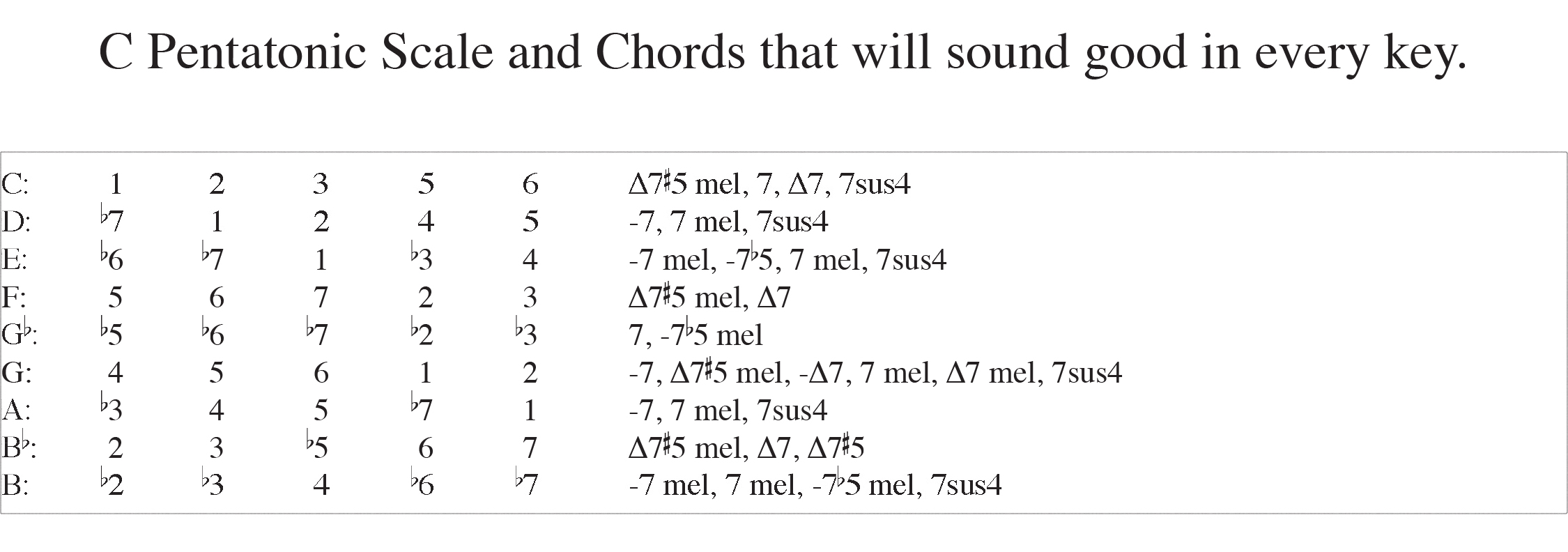
Below is an example from the “Essential Scales” book showing how you can apply a Major Pentatonic in all keys:
Please note that a “mel” written after a chord means there is an avoid note, so the scale can only be used melodically. If there is a “harm” after the chord name this means that the complete scale could be used as harmony and as melody. It that doesn’t make sense to you or you just plain don’t understand it, you need to brush up on your music theory and how chords and scales relate to each other. To gain insight and ability in this area I would recommend the following books:
1. On the left side you see which degree each note of a C Major Pentatonic would be in every key:
2. On the right side of the chart you can see which chord(s) work with the notes of the C Major Pentatonic. Remember the notes on the left are transposed so you can see their relationship in each key. So you can see for instance that a C Major Pentatonic works over a “Gb7” chord:
Let’s look deeper into why you can play a C Major Pentatonic over a “Gb7” chord. Playing a C Pentatonic scale over a “Gb7” chord works because each of the notes of the C Major Pentatonic scale are either chord tones or available tensions. The reason this works is because all of the notes of C Major Pentatonic are either chord tones or available tensions on a Gb7 chord. For instance: “C” = flat 5 in “Gb” is an available tension on a “7” chord, “D” = flat 6 in “Gb” is an available tension on a “7” chord, “E” = flat 7 in “Gb” is a chord tone on a “7” chord, “G” = flat 2 in “Gb” is an available tension on a “7” chord, and finally A = flat 3 in Gb is also an available tension on a “7” chord. So all of the notes of C Major Pentatonic are either chord tones or available tensions.
Some More Ways to Use the Chart
You could also take just one note of the C Major Pentatonic Scale and see which chords you could use over that note. For instance if we took the note “G” from the C Major Pentatonic you can see outlined below:
You can see what “G” would be in every key. You could then look to the right and pick a chord to use. For instance if we decided that we wanted to use the “G” note with some kind of “A” chord we go down to the A row and see that “G” is the “b7” in “A,” and then go to the right and choose a chord. In this case I chose “A7sus4.”
Extremely Useful Charts for Modern Reharmonization
So you can see that these Modern Rehamonization charts are very useful, and provide a quick way to apply scales to other chords or to find chords that work with a specific note. There are other ways to great modern reharmonizations which I discuss in Chord Reharmonization Overview post.
Check out other Bruce Arnold blog entries on brucearnold.com here
You might enjoy checking out the “Music Education Genealogy Chart” located on my artist’s site. You will clearly see the historic progression of pedagogy that is the basis for Muse Eek Publishing Products. Great musicians throughout history have been studying the ideas presented by Muse-eek.com which derives its content from a a lineage that stretches back to Scarlatti!
Modern Improvisation is a concept that I’ve investigated quite a bit over the last 25 years. I first started learning about this when I attended the Berklee College of Music, but I was most influenced by my private teachers, including but not limited to Mick Goodrick, Jerry Bergonzi and Charlie Banacos. Many of the topics I cover in my books are derived from what Charlie Banacos taught. If you would like to see the music genealogy of Charlie Banacos and some of his students check out Bruce Arnold”s Music Education Genealogy Chart.
Working Past Banacos Studies
Charlie certainly pointed me in the right direction and you can definitely see his influence on how I put courses together. But many of the books I mention here are not specifically what Charlie taught me, but rather, further explorations of what he had me work on throughout my 5 years of studying with him. I learned many things from all these aforementioned teachers, but in this post I’ll limit our discussion to theories of contemporary improvisation that I’ve formulated. The list is always growing, so you should check back periodically to muse-eek.com for updates.
Pitch Class Set Improvisation
The material herein either teaches a technique, explains a theory, gives exercises to master an improvisational concept, or directs you to reference books. Many of these books cover the theory of what I call “Pitch Class Set Improvisation,” a concept of applying pitch class set theory to jazz improvisation. Charlie Banacos never taught pitch class set theory though I did study his 23rd chord concept which is a way to organize three 7th chords in a 12 tone aggregate. You can hear an example of writing and soloing with 23rd chords by listening to the composition “Blue Eleven” from my recording of the same name. You can find a complete list of these 23rd chords in the book Tools for Modern Improvisation. Charlie also had me singing through Arnold Schoenberg’s “Funf Piano Pieces.” which I ultimately ended up recording with the group “Spooky Actions.” You can see a list of that group’s recordings here.
Pitch Class Set Theory and Improvisation
As I have said, most of the courses listed here are certainly influenced by Charlie Banacos’ techings. But to my knowledge Charlie never dealt with pitch class sets. I never heard him mention the concept. My personal opinion is that pitch class set theory is a great way to organize sound and many structures that are used in pitch class set theory provide an array of improvisational ideas and options. Therefore I call these concepts “Pitch Class Set Improvisation.” If you are new to pitch class set improvisation I suggest getting the Sonic Resource Guide. I also give examples of how “Pitch Class Set Improvisation” has been used in the classical recording I’ve done in Improvising on Classical Masterpieces.
Real Use is the Best Practice
One thing I want to stress is that the theories in these books are not just abstractions to me. I’ve used them extensively in my recordings, as compositional and improvisational tools. They are very flexible and can also be used across multiple idioms. Follow these links to a CD that uses “Pitch Class Set Improvisation” in a Jazz, Rock, Metal, Country, Free Improvisation,World Music and Classical setting. I believe that in order to really understand an improvisational concept you need to write and improvise within it. Many of these books were written as a method that I developed to widen my own skills with “Pitch Class Set Improvisation.” Therefore you may also find them useful if you find the sounds created by these concepts intriguing, and want to work with them..
Books of Modern Improvisation
I’ve written many books on “Pitch Class Set Improvisation.” Here are a few example pages from these books and some explanation on how you might use this material.
Sonic Resource Guide
1. Sonic Resource Guide. This book contains the combination of pitch class theory and jazz improvisation that is the basis of “Pitch Class Set Improvisation” theory. Sonic Resource Guide. really explains the exact method by which both can be combined. It is a must own if you want to fully understand the principles I’m using to make my “Pitch Class Set Improvisation.” The book also has a lot of information on the application of pitch class sets. In general it shows what chords would work (in all keys) over all 220 possible scales. It also contains many other lists. Here are a couple that I use a lot:
All possible Hexatonic scales that can be derived from six and seven note scales
A list to input any scale and find its prime form
Lists of 12 tone aggregates that can be formed from the 12 three note pitch class sets.
All Hexatonic scales broken down into two trichords.
A list of Unique 3 and 4 note subsets for each scale
The scale in note names, its prime form and the degrees
A list of every chord that will work over this scale in every key.
The scale that would be formed by the 6 notes you are not using. i.e. the Symmetric Difference.
A list of all 3 note subsets in prime form.
A list of all 4 note subsets in prime form.
A list of all the ways to make this scale into 3 two note groups. A great improvisation method.
A list of the ways in which you can make hexatonic groupings via two three note groups. This is another great improvisation method.
You can see that just one page of the Sonic Resource Guide can give you great detail on every scale and show you not only how to use it over chords, but additional information that you can use in various improvisational settings. By the way, Charlie would have called hexatonic scales broken into two trichords “Non-Tertial Double Mambos.” The idea of going back and forth between two three note groups is “Double Mambos.” I discuss this in the Tools for Modern Improvisation or My Music books. My Music covers more of my older music while Tools for Modern Improvisation includes newer concepts and composition.
Ultimate Arpeggio
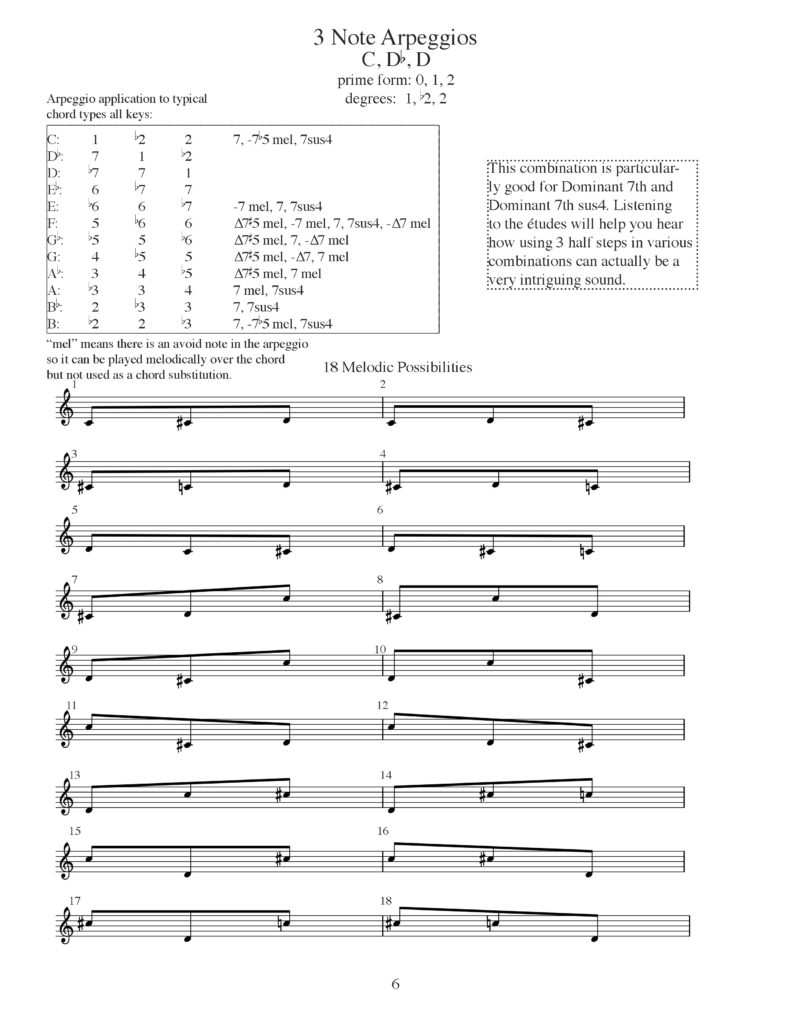
2. A related book about trichords is Ultimate Arpeggio. It’s a look at all possible three note groupings of which there are 12 based on pitch class theory (see Sonic Resource Guide). It also covers the method of using any of the 3 note groups as melodies to outline chords. You are then given études to develop the idea of superimposing these 3 note groups over common chord progressions. All Études have MP3s at three different tempos to help you learn. Below is a couple of excerpts from this book. First we have the 012 pitch class set. This page includes the chords this scale can be played over. It also includes the 18 possible ways you can play this 3 note arpeggio.
Ultimate Arpeggio includes Études for all 12 three note combinations. These Études take the pitch class set and apply it to common chord progressions in all keys. MP3s are included so that you can hear the examples, but also gradually increase the tempo as you practice the exercise.
ChopBuster
3. Most of the ChopsBuster books cover different applications of 3 and 4 note groups to various situations. Most are very long exercises covering some possible application of a particular concept in all permutations or keys or both. There are over 18 ChopBuster books that deal with some aspect of “Pitch Class Set improvisation.” Below is an example from ChopBuster: Two Trichord Ascending and Descending Scales. This course shows you some awesome ways to play the 0,1,2,6,7,8 pitch class set. This is the same pitch class set we showed earlier from the “Sonic Resource Guide.” Notice that you get these melodic lines in all keys and the chords that this line works over are also included. If you want to hear this 0,1,2,6,7,8 pitch class set in a real musical setting check out the video at the top of the page for the Trichord Sweeps Pairs Course.
Ultimate Three Note Chord Lexicon
4. Ultimate Three Note Chord Lexicon looks at each of the 12 three note groups and gives you all the chords derived from these three note groups as well as études and more information. It provides guitar voicings for chords, too. It’s an extensive project and as of this writing I’ve only finished 012, 013 and 014.
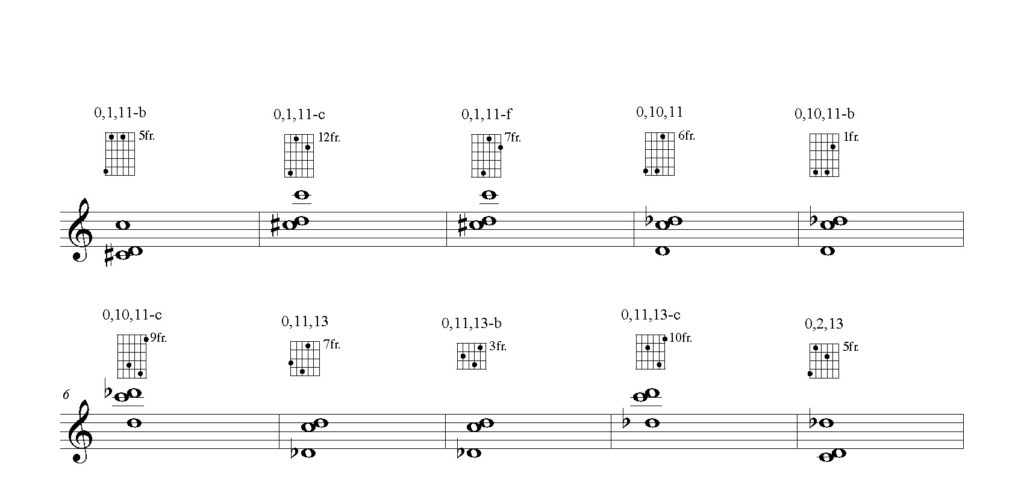
Here are a couple of examples for the 012 book. All 012 voicings are included for all instrumentalists, but chord voicings that work on the guitar are also provided. Here is an excerpt from the 012 chord voicings for guitar:
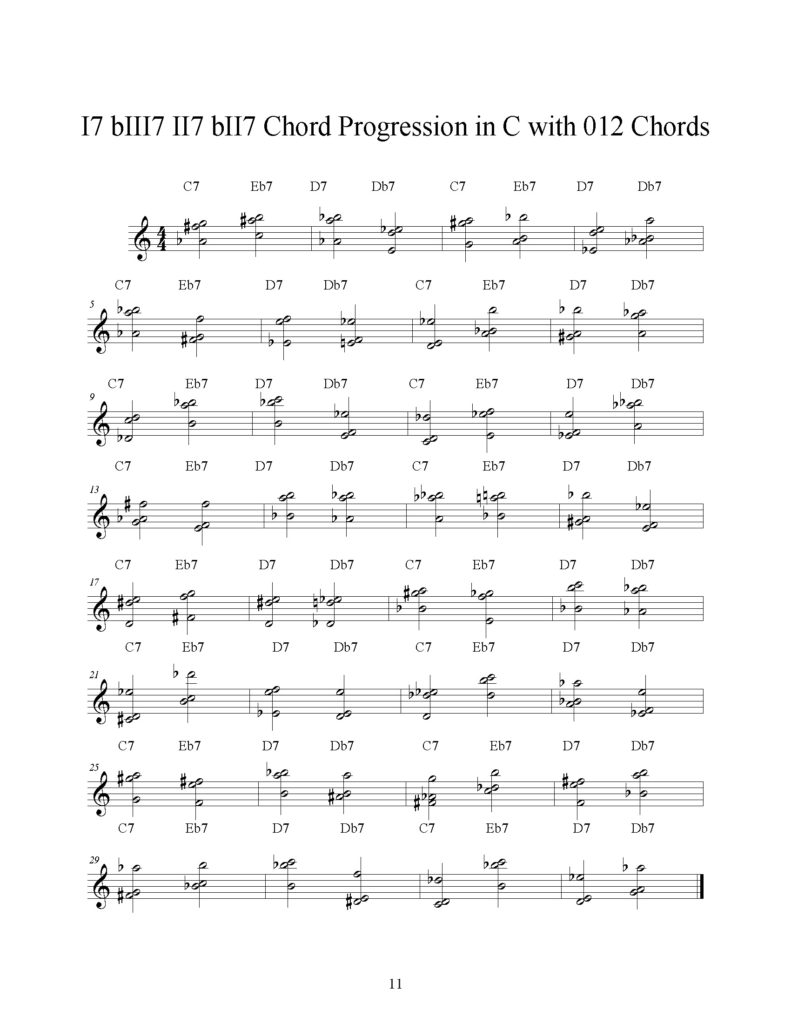
Voice leading through common chord progressions is covered in all keys. Here is an example:
Midifiles and MP3s at multiple tempos are includes as are further Études in different styles. These are some really hip sounding Études, and are highly recommended; I think you’ll get a kick out of them.
013 Hexatonic Études
5. 013 Hexatonic Études is études using 013 pitch class set over dominant chords. From working with these études you can really hear the application of 013 over dominant chords. From there you should extrapolate that this idea would work on any of the 12 three note groups. These études are great for sight singing, ear training, sight reading and generally gets the sound of 013 into your playing. Midifiles and MP3s at multiple tempos are included. Again highly recommended. Here is an example:
Symmetrical Trichord Pairs and Trichord Sweep Pairs
6. Two books Symmetrical Trichord Pairs and Trichord Sweep Pairs look at the combination of two three note groups for all 12 possible 3 note combinations. IMHO these are super hip melodies that can be played over various chords. The “Pairs” are organized by chord type i.e. Major, Minor, Dominant etc… Below is an example from the Symmetrical Trichord Pairs course. It shows how to combine two 013 trichords to fit over a major 7 chord.
The Trichord Sweep Pairs Course looks at using the same idea of symmetrical trichord pairs but in an arpeggio. This course gives you 2440 pages of sweep patterns, including guitar diagrams for many of the sweeps. The page below shows you another section of the course that just gives notes for sweeps but also includes fingerings for easy to play sweeps.
Time Transformation is a combination of 027 027 études with superimpositions of various meters over other meters. It’s a must own in my opinion because it covers pitch class set improvisation AND time superimposition within one course. This book gives you études in 3/4, 4/4, 5/4, 6/4 and 7/4 where 027 027 is used in and outside the key center. You can also superimpose these études over the MP3 grooves that come with the course. Below is an example from the 3/4 Étude in E minor. Notice how the 027’s switch in and out of the key center. This creates a very interesting modern improvisational sound.
By the way Set Theory for Improvisation 027 027 contains a subset of Time Transformation so only buy that book if you just want to dabble in 027 027 concept with some études but no time superimposition. Set Theory for Improvisation 027 016 is a great book because it gives you some études taking 027 016 in and out of the key center. Great melodic lines!
Tertial Octatonics
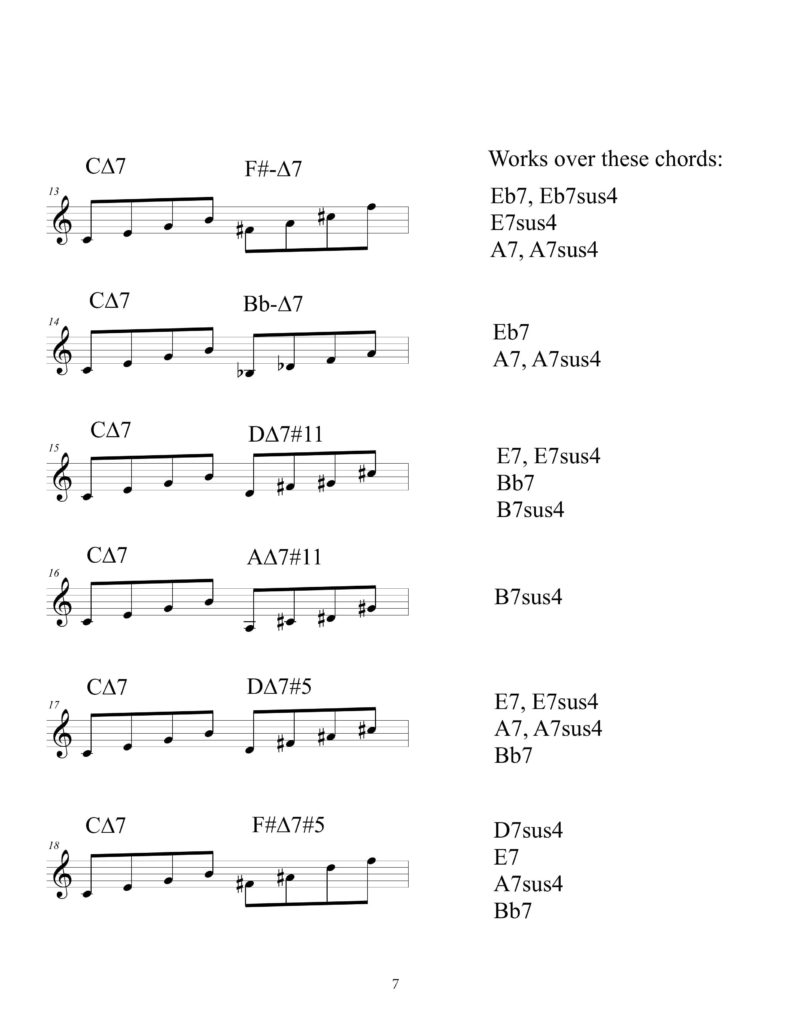
8. Charlie sometimes talked about using two 7th chords to form an Octatonic scale. Tertial Octatonics looks at all possible combinations of two 7th chords to form an Octatonic scale. The Course contains lists of which Tetrads (4 note group) can be combined with another Tetrad to form an Octatonic Scale. This is a very hip sound and is highly recommended: Here is an example of the two tetrad combinations from the Tertial OctatonicsCourse:
There are étude/permutation exercises to help you apply and hear the sound of each Two Tetrad combination. Again these are great melodic lines to create a modern sound in your improvisation and composition.
Related to this concept is Tertial Intervallics which looks at combining “Charlie’s 13 chord types.” This course gets more into the pure use of intervals as a method of improvisation. Charlie often would use previous courses of study to combine into a new sound. Tertial Intervallics is one way to apply previously learned 7th chords into modern melodic lines. Charlie would sometimes refer to these concepts where you take garden variety scales, chords, approach note figures and apply them in a different way as “Mushrooms.” Because playing these lines “Mushrooms your Playing.” In other words by applying things you know already in a different way your musical ability “grows like a mushroom” i.e. expands. Below is an example from the Tertial Intervallics Course:
Midifiles and MP3 recordings of these Étude/Exercises are included with the Tertial Intervallics Course.
Final Note
One final note: there are other courses such as Harmonic Analysis, Scale Analysis, Tools for Music Mastery One and Essential Scales that give you the background of the way Charlie saw harmony, scales, and scales with approach notes. Tools for Music Mastery Two contains the application of Charlie’s Rhythm Exercises to études. It’s also a great book for ear training.
This gives you an overview of the courses, and some information to show you how each book fits into the realm of modern improvisation. As always, I look forward to your questions.
Check out other Bruce Arnold blog entries on brucearnold.com here
I also recommend checking out my duo with Judi Silvano called Sonic Twist®. There is a lot of great examples of me using pitch class sets.
Bruce Arnold Music Education Genealogy Chart
You might enjoy checking out the “Music Education Genealogy Chart” located on my artist’s site. You will clearly see the historic progression of pedagogy that is the basis for Muse Eek Publishing Products. Great musicians throughout history have been studying the ideas presented by Muse-eek.com which derives its content from a a lineage that stretches back to Scarlatti!
I get many musicians who contact me about how to approach sight reading music. For many musicians it’s more like “fright reading” that sight reading. I’ve taught at a lot at Universities such as Princeton University and Berklee College of Music. In most cases I’ve found that students ability to read is not up to a professional and many times they have certain issues and weaknesses that I will discuss below. I hope these Sight Reading Recommendations help you master the art of sight reading music.
Reading Different Manuscripts
The first sight reading recommendation is to read different manuscripts. You need to train your eye to be comfortable with many styles of penmanship and music fonts, as you never know what will be thrown at you unexpectedly (see #10). Along with the many books I’ve written for Muse Eek Publishing Company I also place a lot of public domain classical music in Muse-eek.com’s “Member’s Area” which is free to join. By combining targeted sight reading music books that I’ve created and the many engravings of classical music a student gets exposed to many style of presenting music within a manuscript.
Feel Time Not Count Time
The second sight reading recommendation is to Learn to FEEL time and not count time. I usually get into this with students that have read for a while. That said, this is a crucial step in taking yourself to next level of rhythmic understanding. Understanding the ideas presented here will greatly benefit your ability to sight read music, have a great feel when you play and strengthen your foundation. One benefit of understand the idea of “long line rhythm” is an ability to superimpose rhythms and feels when improvising. I discuss this a lot in the Big Metronome. Also the use of the MetroDrone is not only super helpful with these issues, but working with it also helps with your ear training at the same time as you are sight reading.
The next 5 points are dealt with in New York Guitar Method Ensemble Book One which goes into more depth on the subject and has midi files and MP3s for some exercises which will really help you develop these concepts.
Beat Reading
The third sight reading recommendation is to understand your eye movement when reading music and how that directly affected by its ability to move ahead of the music. You can learn to take in information much faster than most people, and read more accurately at the same time, if you can master the technique of what I call “beat reading,” where you read only what is on certain beats of the measure. This will make a huge difference in your speed and ability. This is “beat reading” and it is your secret weapon to improve your sight reading in an incredibly short period of time.
Different Feels
The fourth sight reading recommendation is understanding different “feels” in music. When of the main “feel” considerations is understanding Straight 8ths vs. Swing 8th. As many of you know there are two major ways to feel eighth or even sixteenth notes: where you play them straight (like in rock music) or with a swing feel (found in blues and jazz). In the latter, you are playing eighth notes something close to beat one and the 3rd note of a triplet. There is much more to this idea of feel, especially when we talk about a swing feel, but I’m just touching on key points.
Learning Rhythmic Levels
The fifth sight reading recommendation is learning the different ways of counting through a piece of music. Depending on the style, tempo and other considerations you may want to count the music with quarters, halves, whole notes etc… There is no one source to learn what is appropriate it what situation but I will say that working through the Time Studies Books will help you realize all the metric levels that are involved when become a great sight reader. Knowing how to count based on the metric level or odd time signature situation can be crucial to your success. I would start with the Rhythm Primer which gives you a lot of suggestions on how to count through a piece of music.
Understanding Rhythm Notation
The sixth sight reading recommendation is understanding rhythm notation. There are two key factors with this. One, for rhythm section players is understanding how to read rhythmic notation along with chords. Second is being able to read on multiple rhythm levels. There are four common rhythmic levels in music. Think of it like this: you could have your basic beat be a whole, half, quarter or eighth note. Fast jazz is written at the whole or half note level, jazz is written at the quarter note level ( but felt at the half note level), Really slow music in any style is written at the eighth note level. The New York Guitar Method Volume One along with the whole Rhythm Series of Books is all about rhythmic levels so it’s an excellent source for mastering each one. This Rhythm Series has now been expanded to twelve volumes covering common rhythms as well as quintuplets, sextuplets and septuplets as well as combinations of these odd groupings.
Mix it Up
The seventh sight reading recommendation is the realization that when you work on reading it’s best to use a bunch of different types of sight reading materials rather than just one book by one composer. Commonly when students decide to learn to read they grab one of Bach’s masterpieces. While it’s great music you should be using more that one book. Bach’s music isn’t going to help you read that chart in a funk band; it’s just not rhythmic in the same way. So mix it up, get written music in as many different kinds of styles as you can to prepare yourself for the real world of sight reading.
Be Consistent in Your Practice
The eighth sight reading recommendation is that you need to be consistent in your practice. I did one hour a day of sight reading for 5 years which put me at a super pro level but if you can do 15 minutes a day within a few months you are reading better than most musicians and in a year or two you will be approaching an “OK” pro level.
Sight Reading Improves Your Musicianship.
The ninth sight reading recommendation is an observation that I noticed about myself and my students. That is that sight reading music improves your musicianship. When you have to address learning rhythm and how to play melodies you get into a host of issues that will help raise your playing, composing and ensemble balance skills. It will help you understand how music is felt and written. It will help you see and solve the problems you might have with speeding up or slowing down as you play. You will be able to understand how to organize music and styles into different notation conventions. It will allow you to get inside a composer’s music to understand their inner workings from a very fundamental place because you are playing, rather than only reading, the music. I could go on, but again these are just a few key points among many.
Sight Reading Pays
The tenth sight reading recommendation is a simple consideration. You can make money sight reading music. I have many examples like this but this is short and sweet. I got a call 8pm at night when I was living in Boston. The guitarist that was supposed to play with the Boston Symphony Orchestra at Symphony Hall in Boston the next day just had an attack of appendicitis. I walked into symphony hall and started sight reading on the spot from a book that I’d never seen before. Maybe I missed two or three notes throughout the evening but no one seemed to notice. But I made enough money from that one gig to live in Boston for six months. Reading pays, my friend.
These 10 sight reading recommendations are some of the important subjects I talk to students about from the onset of their lessons. I’m constantly added sight reading titles to the Muse Eek Publishing Company list so please check there for updates. If you decide to get away from “fright reading” and move towards sight reading get in touch, and I’ll make some recommendations.
Check out other Bruce Arnold blog entries on brucearnold.com here
You might enjoy checking out the “Music Education Genealogy Chart” located on my artist’s site. You will clearly see the historic progression of pedagogy that is the basis for Muse Eek Publishing Products. Great musicians throughout history have been studying the ideas presented by Muse-eek.com which derives its content from a a lineage that stretches back to Scarlatti!
The Sonic Resource Guide is a guide to pitch class set theory, providing a structure with which to organize music. When utilized, it will broaden your improvisational and compositional palette leading to a personal, and unique sound.
What is a Pitch Class Set?
Basically, a Pitch Class Set is just a fancy name for a scale. This scale can have between 2 and 12 notes. What makes it a bit different is that a Pitch Class Set also includes many groupings of notes that we don’t usually think of as a scale like a dyad or triad.
What sets a Pitch Class Set Apart from a Scale?
What sets a pitch class set apart from a scale is how these 2 to 12 notes scales are organized and categorized. A good example is a three note scale. A Major Triad could be thought of as a three note scale. If you consult the New York Guitar Method Volume One you will find a complete list of all the possible three note scales. There are 49 three note scales in total. These 49 possibilities are listed as degrees. For instance a Major Triad is 1,3,5 and we can then figure out the inversions from there i.e. 3,5 up to 1 is 1st inversion and 5 up to 1 up to 3 is 2nd inversion.
Let’s Dig a Bit Deeper
But this can be a very inefficient way to work with music. As you dig deeper through this list you also find 1,b3,b6. Well, that is actually the 1st inversion of a Major Triad in Ab right? Let’s think of both instances starting from the note “C.” If we take the 1st inversion of 1,3,5 the “3” is “E.” We have 3,5 up to 1 which is E,G,C. If we take 1,b3,b6 and make “1” an “E” we again have E,G,C. So both are the same. This can make processing a list such as the one you find in the New York Guitar Method Volume One tricky. If you aren’t a pretty advanced musician, organizing 48 three note combinations plus their inversions is a crazy amount of work. Besides, in some cases those inversions are already listed as other groups! In my opinion, this is not an effective way to practice with or organize sound. Not to mention that remembering 48 plus inversions is a daunting amount of material to put to memory.
Why Pitch Class Set and Prime Form?
Now let’s look at the difference if you think of scales as pitch class sets and establish their prime form. Go back to the New York Guitar Method Volume One list and this time choose 1,2,5. In “C” that would be C, D, G. But you would also find 1, 4, b7 and 1,4,5 in the list. But wait! Aren’t all three of these combinations the same things? 1,2,5 could be C D, G. If we make “1” a “D,” 1, 4, b7 would be D, G, C. Then if we made “1” a “G.” 1,4,5 would be G, C, D. Hopefully you are starting to see that we are running around in circles with this list and hopefully we could organize things more easily, so we aren’t always taxing our brains to make sure the information is not overlapping or redundant.
Enter Prime Form
With Pitch Class Sets there is a thing called “Prime Form.” The idea behind “Prime Form” is to reduce all scales (pitch class sets) into “one” grouping of notes so we don’t have to remember so many combinations as we have seen in the previous examples.
Example of Prime Form
“Prime Form” always reduces any group of notes into its smallest interval combination. For example C, D, G is already in Prime Form. You would find that if we called “C” “0” or the starting point and “D” “2′ because it’s two half steps above “C.” Then we called “G” “7” because it’s seven half steps above “C.” Using this system C,D, G can be reduced to a scale i.e. a pitch class set that is “027.” Let’s look at another example; what if we had D,G,C. If we start from “D” and make that “0” the D= 0, G is up a fourth so it’s “5” and C is up a minor 7th from “D” so it’s 10. So a D,G,C is a 0,5,10 but of course we can reduce this to 027. This is why changing your thought patterns over, so that you think of everything you play in its Prime Form, you have drastically reduced the number of things you have to remember.
Less is Best
When you are an improvisor the less you have to think about, the more spontaneous and creative you can be. So I call improvisation where pitch class sets are a part of your thinking “pitch class set improvisation.” This technique gives you a serious leg up on organizing improvisational ideas, not to mention creating some really awesome contemporary-sounding melodic and harmonic music.
Reducing our 48 Three Note Combinations
If we shrink all 48 three note scale down to their “Prime Form” we only have 12 three note combinations. OK now we are talking about something that is easy to remember. Anyone can remember 12 different groups of three notes. This is why working with The Sonic Resource Guide is so awesome. It shrinks every scale down to its smallest combination, which means in total there are only 220 possible scales that exist with all 12 notes.
The Sonic Resource Guide is really a reference book that provides you with all kinds of information about chords and scales using Pitch Class Set Theory. This helps you to switch your organizational principle over to a pitch class set improvisation way of thinking. With this book, unlike others on the same subject, everything is presented simply and clearly, without advanced math or equations. In addition, unlike these other books which are targeted toward classical music, the Sonic Resource Guide is for any improvisor, no matter the genre. This makes it unique. Using it, you can organize all scales and chords into a system that is logical and shows you relationships that might have been previously unseen. Additionally, the Sonic Resource Guide reduces all possible scales down to a manageable 220 possible combinations.
Organization Principle = Pitch Class Set Improvisation
The Sonic Resource Guide‘s logical organizing principles allow a musician to see all of the possibilities behind any scale (Pitch Class Set) in a clear and concise way. So really we are switching over to a pitch class set improvisation way of thinking. If you are a musician who wants to explore new sounds for improvisation or composition then this book will be a great resource that you can refer for years.
Bridging the Gap
The aim of The Sonic Resource Guide is to bridge a gap in music education; it is a balance between the highly mathematical approach to pitch class theory and the often limited scope of jazz improvisational methods. By demonstrating numerous theoretical relationships that an improviser can use to create original musical content, the Sonic Resource Guide provides a breath of fresh air and sound to your musical expression.
Jazz Theory Within a Pitch Class Setting
Within the The Sonic Resource Guide you will find various melodic and harmonic relationships of each pitch class set listed. This makes it easy to locate and utilize these relationships within your own playing. Along with each pitch class set is a listing of possible related jazz chords so that you can plug these sounds into your playing immediately.
Sonic Resource Additional Content
Where appropriate a listing of all three and four note chords can be found to aid in creating varied and unique harmonic palettes, as well as three, four, six and eight note subset relationships to help in exploring subset based musical ideas. All musicians will find this book user friendly because all Pitch Class Set (Scales) relationships are listed as both pitch names and scale degrees. Set theory students will find each pitch class set is expressed in its prime form so it will be easy to navigate.
Using Pitch Class Set Improvisation as a way to Organize
Thinking and organizing via pitch class set improvisation will give your thought processes much more clarity. You will be able to create any scale on the fly and immediately discern their hidden relationships. You can investigate the common scales you know, or create new scales at your whim. All this can be done quickly by using the index which helps you locate any group of notes in its prime form, which will then be your guide to finding the scale within the book. There is also a brief theory section exploring some of the many uses of the information presented.
Supplemental Materials
Think of the The Sonic Resource Guide as a reference book where you find cool relationships. But now that you’ve found some, how do you apply them? To that end I’ve created a series of books. Here is a list of them to check out, to help you develop pitch class set improvisation ideas.
Pitch Class Set Improvisation is Not Style Specific
Many times people think that using Pitch Class Set Improvisation techniques means you are playing “avant garde” melodies and chords. This could not further from the truth. Pitch Class Set Improvisation can be used with any style. Here are some examples:
Rock/Heavy Metal Pitch Class Set Improvisation: Vanishing Point
Bruce Arnold Music Education Genealogy Chart
You might enjoy checking out the “Music Education Genealogy Chart” located on my artist’s site. You will clearly see the historic progression of pedagogy that is the basis for Muse Eek Publishing Products. Great musicians throughout history have been studying the ideas presented by Muse-eek.com which derives its content from a a lineage that stretches back to Scarlatti!
TrueFire, Bruce Arnold and many of NYC’s best guitar educators team up to present: Bruce Arnold’s Jazz Guitar Summit NYC. An incredible 525 minutes of handpicked insights from Jazz Guitar Masters.
Among the plethora of great guitarists, it is the rare one who can also communicate ideas and techniques. But these were exactly the kinds of musicians that guitarist and educator Bruce Arnold gathered at his annual Summer Guitar Intensives in New York City. He knew that the students would pay more attention if they knew that their teachers were not just giving them great information, but that they were also monster players. So he chose very carefully and created an environment for learning that truly was a Summit. When the educational video company True Fire learned of this project, they offered to videotape selected lessons, and the result is Bruce Arnold’s Jazz Guitar Summit NYC, a course of almost 9 hours of enlightening demonstrations, and a cross section of what some of the best guitarists around were fascinated by within that juncture of time, as well.
Interestingly, the artists involved were not all specifically known as jazz players. For example. Sheryl Bailey has a solid reputation for her no holds barred rock and roll sound, and Dusan Bogdanovic is a formidable, touring classical guitarist. Yet all of these musicians had something valuable to add to the vocabulary of jazz, and they do so with clarity and precision. (And it should also be mentioned that this is also a gender neutral gathering; all choices were made on quality and content with no old boy network in sight!)
Each player has his or her own particular item to teach, and the curriculum is extensive. Scales, modes, reharmonization, improvisation, comping and playing technique are only some of the subjects covered. In particular the sessions with Dusan Bogdanovic, Leni Stern and Brad Shepik shed light on how to play and adapt African and Balkan polyrhythms to jazz, a subject of increasing interest these days. As Bruce puts it no matter what genre you are interested in, from jazz to classical to world music, you will find something here to chew on. Im proud of this course. It is full of fascinating ideas that are just waiting to be explored. I think that after learning all that you think you can from it, you will return to it –maybe years later– and realize there was something you didn’t quite catch, or maybe were not ready for. And now you are.
This summit of distinguished faculty includes: Bruce Bartlett, Sheryl Bailey, Roni Ben-Hur, Dusan Bogdanovic, Gene Ess, Mimi Fox, Jane Getter, John Hart, Randy Johnston, Peter Leitch, Peter McCann, Brad Shepik, Leni Stern, Kenny Wessel, Jack Wilkins and of course, Bruce Arnold.
Bruce Arnold Music Education Genealogy Chart
You might enjoy checking out the “Music Education Genealogy Chart” located on my artist’s site. You will clearly see the historic progression of pedagogy that is the basis for Muse Eek Publishing Products. Great musicians throughout history have been studying the ideas presented by Muse-eek.com which derives its content from a a lineage that stretches back to Scarlatti!
The intersections between jazz and classical music have long fascinated me, and within my own music I often use contemporary classical ideas. For the most part this was a personal journey that started bearing fruit back in the early 1990’s from a combination of my interest in hexatonic scales and a thirst for knowledge that was spurred by access to the Princeton University Music Library during my 30 year tenure there as a music instructor. But this journey was also started in part from the influences that my teachers Charlie Banacos and Jerry Bergonzi had on me in my formative years and their ways of organizing materials for practice.
I recently found the music education genealogical chart of my teachers Charles Banacos and Jerry Bergonzi Interestingly it is also a timeline showing the flow of the teaching of classical music into the teaching of its elements as applied to jazz. I think people generally don’t realize how the techniques used in composing and playing classical music are closely related to their counterparts in Jazz.
Looking at the genealogy chart, I also realized that I am the product of these great music teachers, and those who taught them. I owe so much to Charlie and Jerry because they took the time to show me what they knew, all in the cause of education, and that is why I feel compelled to pass the torch to my own students.. Charles Banacos and Jerry Bergonzi, were gurus in the fullest sense of the word. Every lesson with them was a revelation that encouraged me to study and practice more, and I would not be the musician I am now, without their guidance.
It turns out that the methods I’ve both learned from, and have presented in my books have a long history. They did not start with Charlie or even his teacher, but have been used to educate countless musicians over the ages, many of whom went on to become masters we still admire today. From looking at the Genealogy chart below you can see it’s an impressive list; virtually a Who’s Who of music running from the Baroque period through Classical, and Romantic and right up to Jazz. I am really amazed (and humbled) when I look at this.
Bruce Arnold’s Music Education Genealogy Chart
Although it is hard to find much information on exact teaching methods prior to Czerny, when I perused his various books it confirmed that many of the concepts he taught were also taught by Banacos, Bergonzi, Chaloff and Vergerov having been passed down intact, and one can assume that these ideas were picked up from their predecessors, such as Beethoven, Mozart, and Haydn, as well as anyone who had studied with them.
This certainly explains why some key elements that are found in my books appear in Czerny’s Complete Theoretical and Practical Piano Forte op 500 from 1839 as well. I found many basic concepts such as how to learn scales, arpeggios, ear training and rhythm could be traced from what I was taught by Banacos and Bergonzi back through to Czerny and presumably beyond. I did unearth an interesting concept used in the time of Czerny. In early music instruction a student had a lesson every day rather than once a week. This is precisely why I created muse-eek.com and offered free email interaction, so that a student can get answers to their questions immediately, without waiting for the next lesson. This ensures maximum productivity at practice time, between lessons. Banacos, who taught correspondence lessons, often told me that he never taught concepts such as ear training through correspondence because you needed closer interaction with a student to teach them correctly. Unfortunately, even though he was intrigued by computers and what they could do, Charlie was not computer literate. We spent many lessons discussing this. He was very curious as to how they could aid in the “multitasking” of musical study –and any student of Charlie’s would understand why!
My teachers’ main principals as great educators were compassion, humility, kindness and a deep sense of caring about guiding a student to fullest potential. Anyone who has studied with Charlie or Jerry would instantly recognize this in their character. I have attempted to follow in their footsteps.
From reading through Czerny’s books and comparing the education I received, here are some of the correlations I have found. I’ve also listed the relevant books or series of books available from Muse-eek.com that I’ve created to help my students master these aspects of their musical education.
1. A student should learn music theory and know what all the notes are on their instrument. Music Theory is a language that should be second nature. A student must learn both note names and degrees when working with various exercises. To help achieve this goal I created:
2. Reading music on one’s instrument is essential, and reading through the music of the great composers is invaluable. I have created a comprehensive series of books on sight reading. The Time Series encompasses a wide range of books specifically addressing the rhythmic aspect of reading. I’ve also created the New York Guitar Method Ensemble Book Volume One and Volume Two which along with many other exercises includes classical music to read by such artists as Corelli, Bach and Beethoven.
3. Technical ease is not achieved through stress or tension. I always encourage ergonomic movement so that there is no wasted energy, or harmful fatigue. Playing through pain or simply holding an instrument incorrectly is a common mistake. I believe it is the main reason students may not attain the mastery they deserve. I wrote Right Hand Technique for Guitar to deal specifically with right hand issues along with the video course Guitar Physiology to demonstrate proper technique.
4. Learning essential scales, chord progressions and other patterns in all keys is crucial to mastering an instrument. This is a simple concept but completely ignored by many teachers. All of the books I have written stress the importance of learning the information in all keys and being able to hear this information in all appropriate key centers. Books such as Essential Scales, Sight Reading Solved,Chord Workbook for Guitar Volume One and Two and the 3 Volumes of Jam Tracks all contain exercises and MP3s that cover all 12 keys.
5. Music should be heard in key centers so it is necessary to learn everything in relationship to them. This is the main point behind my whole Ear Training Series and is the rosetta stone of understanding how to play music. When a student is playing a scale or any other combination of notes they should always hear these notes in a key center. The MetroDrone is a set of MP3s I recommend for every student to help them practice in this way.
6. I always recommend applying everything learned to a real life, real time musical situation. I use Jam Tracks Volume One, Two and Three along with the Direct Application books to get students to apply each technique they learn.
7. Articulation and embellishment are the keys to personalizing ones’ music. Each idiom has its set of articulations and embellishments. A student needs to learn these through transcription.
8. Practicing music in shorter periods throughout the day is better than one long marathon session. This is because our memory is engaged more by repeated short sessions, and we learn and retain information better.
9. Learning all the possible ways music can be notated is key to great sight reading ability. It also teaches you many articulations and embellishments that you can use in your playing.
10. Learning rhythm on an internal level is key to developing full musicianship skills. Through my Big Metronome, Odd Meters, MetroDrone and Time Transformation books I explore the key aspects of developing the ability to feel, rather than count music on various levels.
11. Classical composers were expected to improvise when they performed, although this practice fell out of style for a while. But improvisation plays a major role in musicianship, and indicates an understanding of structure as well as a high degree of creativity. Czerny called this preluding. By applying each thing you learn to an improvisational setting it helps spur artistic expression and an understanding of the techniques you explore.
12. Music must be learned on the micro and macro level especially when it comes to rhythm. My book Sonic Resource Guide explores a Macro understanding of all possible scales and their application. Neither Banacos, Bergonzi nor Czerny taught music using Pitch Class Sets but the way they approached the organization of musical ideas was right in line with the organizational principals of Post Tonal Theory. On the other hand much of my Rhythm Series which helps a student gain basic ability with rhythms. My Big Metronome, Doing Time Series and the MP3s found in MetroDrone which helps a student feel music and rhythm in a larger scope came directly out of ideas I learned from Banacos and the ideas of per mutating rhythms learned from Banacos as well were augmented and further organized via the computer program SuperCollider.
13. A student should use modal sequencing as a means to improve their technique but also to master scales and other musical patterns. Czerny’s books are full of modal sequences as a way to master scales. Both Banacos and Bergonzi basic concepts of learning were centered around permutation of everything ingredient of music. I furthered this idea by creating a series of books called ChopBusters that require a student to apply modal sequencing to common scales but also to various pitch class sets, thus obtaining a more modern sound.
14. You must learn music with a positive state of mind. It is a scientific fact that frustration leads to poor retention. Learning and practice should be an engrossing, joyful experience, not one filled with disappointment and feelings of inadequacy. Patience and self-tolerance will yield the most fruitful practice time.
15. A student should be encouraged through the example of their teacher to strive for playing and understanding music of the highest artistic standards. By checking out the Recordings Section of the muse-eek.com website students can see and hear the scope of recordings I’ve created to demonstrate both the standard and non-standard application of the techniques they are learning.
16. A student should work on a limited number of exercises so that they are not overburdened with too many exercises pulling them in multiple directions. This is a common problem with students who are dedicated, but make very slow progress due to taking on too much at once. Both Banacos and Bergonzi were known for the extra large assignment which they expected you to finish before moving on to the next concept.
17. Performing in front of people is an excellent way to put one into another context and stretch ones ability even it’s just for a friend, and is an under utilized tool for becoming a great musician. I often tell my students how I would play 5 duets a week with other guitarists for years to increase my flexibility, learn from others, and to play various types of music I might not necessarily gravitate to otherwise.
18. As I’ve stated earlier, music is like a language. Learning to express music naturally can be compared to speaking ones native tongue. There is no stopping to think about about individual words or grammar. It just flows.
19. A teacher should repeat the important rules over and over again until the student actually realizes their importance. I’m sometimes criticized that in my books and videos I keep repeating some important aspect of learning music. Through 30 years of experience in teaching I’ve found this is the only way to make sure a student understands a subject thoroughly.
20. In order to learn music you need contact with a teacher. You can’t expect to just go on YouTube and surf and find something that will fix some core problem in your musicianship that is holding you back. Even in Czerny’s time (the early 1800’s ) he was teaching students through letters when he could not do it in person. You can see an example of this in his “Letters to a Young Lady on the Art of Playing the Pianoforte.” Muse-eek.com does this through Skype and email to keep the distance learners in touch to make sure they are developing correctly.
21. By reading through Czerny’s books I can see that successful teaching techniques that I was taught, reach way back into the past and have been taught to many of the great musicians in history. Here are some of them:
Strive to be able to play all notes with equal velocity to acquire smoothness and musicality.
The ear develops more slowly than the eye; teach and learn accordingly.
Always learn a piece of music starting at a tempo that is comfortable. Once it is perfectly played, speed can be adjusted. This will avoid engraining poor techniques and mistakes.
If a piece of music is too difficult to learn then learn one element at a time and then try putting the whole piece together.
Do not try to play things that are above your level. Work up to these goals over time or play the pieces at an extremely slow tempo.
Solfeggio is an excellent tool for understanding and developing your ear when not using your instrument.
Correct, ergonomic fingering on any instrument leads to maximum proficiency.
Understanding that time and space are infinitely divisible. While rhythmic accuracy is of course important there is know end to the finding the exact correct placement of a rhythm. This is why human feel is so important to how music is performed and why both Banacos and Bergonzi stressed listen and learn the music of other great musicians.
22. Every scale or group of notes creates a number of modes equal to the number of notes in the grouping. Remembering that these groups in turn can create unique key centers and learning to think and hear these key centers is crucial to understanding music on a higher level. This is really the core of the ear training taught by Banacos. The common idea of learning a scale and then “thinking” this scale in situations where it is not the key center is a very unmusical and fruitless approach to learning music. For instance thinking a C Melodic Minor Scale over a B7 Altered chord is not recommended unless you are hearing the B7 Altered in the key of C. My Secondary Dominant book looks at the proper way to approach the learning of scales within a key center.
As I have stated before, in Czerny’s time it was expected that a master musician would be able to improvise not only on a given piece of music but be able to improvise a prelude that embodied the spirit, content and feeling of a given piece. I believe this is still true today. Another common practice from Czerny’s time was reading in all clefs which enabled smooth transposition and the ability to read any score. Charlie Banacos stressed this in my lessons making me read through Bach’s two part inventions in all clefs. It worked wonders.
I seem to be one of the only students who actually asked Charlie Banacos where he got his ideas for the techniques he taught. He recommended many books to me and you can find a list of those in the Further Investigations section of this website.
2014 Guitar Intensive Workshop will be starting in 2014 featuring some top educators! Workshops throughout the year that will include weekend or full week intensives in various parts of the USA.
Guitar Intensive Workshop
Guitar Intensive Workshop
A new Summer & Year-Round Special event Workshops which will combine cutting edge guitar education with private lessons and workshops by the finest world’s finest guitarists will be starting in the summer of 2014. These one week workshop offers courses covering a wide range of subjects and a diverse ensemble program tailored to the needs of the aspiring student of contemporary guitar. Here are our core faculty Mimi Fox, Alex Skolnick, Stuart Hamm and Bruce Arnold and we will soon be announcing the remaining educators.
Courses give an in depth look into the fields of music theory, time and improvisation and are geared towards the intermediate to advanced guitarist. Ensembles concentrate on sight reading, improvisation, solo guitar playing and other subjects important to a guitarist’s development. We also offer a wide range of master classes and performances that are scheduled weekly throughout the intensive. The courses and ensemble program are cutting edge and focus on developing a solid foundation in music theory, ensemble performance and sight-reading. The camp climaxes with full-fledged concert(s) in which both students and educators will participate.
These intensives will be located throughout the USA and then expand globally over time. If you have interest in this intensive please shoot us an email.
Guitar Intensive Workshop Information
You will find more specific information on courses, private instruction, ensembles, required books, daily events, application and audition information, meals and housing, fees and age requirements along with the bios of the participating faculty on our forthcoming website.e.
Unlike most summer guitar programs you will work with a highly organized approach to music. Much of the information you will work with is not available in any other college program or course. All courses are college level but are presented so that most high school age students will have no problem with comprehension. All instructors at this intensive have a proven record of educational expertise. Their music educational skills run the gamut from creating and running whole music programs at the college and pre-college level to music instructional books and DVDs. These clinicians also are seasoned live & studio recording guitarists.
Full and partial Scholarships are available for the cost of the workshop. If you have interest please contact us below.
Contact us for further information on anything presented here or if you have general questions.
Bruce Arnold Music Education Genealogy Chart
You might enjoy checking out the “Music Education Genealogy Chart” located on my artist’s site. You will clearly see the historic progression of pedagogy that is the basis for Muse Eek Publishing Products. Great musicians throughout history have been studying the ideas presented by Muse-eek.com which derives its content from a a lineage that stretches back to Scarlatti!
We’ve been hit with what has to be called a perfect storm of setbacks here. First Hurricane Sandy swept away our recording studio, so 150K worth of instruments and recording gear and a year’s worth of new projects are literally down the drain. We are hoping for some relief from the Government, but we are just one among thousands and as it always goes with banks, they will gladly loan you money if you already have something in the bank as collateral. Unfortunately that’s not our case, nor is it the case with most of the folks who sustained losses here. But we’ve spent days filling out forms and sending them in and we’ll see if we can get any relief. Cross your fingers for us, all of you!
Saving the Muse-eek.com Studio
Between trying to save the studio Muse-eek.com used and trying to deal with getting our new website launched (untold hours sitting at the computer 24/7), Bruce injured his back and is still recovering. To literally add insult to injury the company that was recommended for building the new website talked a good line, but was not up to the task, we could go into a whole page of specifics but let’s just say we fired them today and are now searching for a site building company that cares about the quality of our products as much as we do!
About Muse-eek.com
That said many things are working just fine; you can visit our new site and order books but don’t be surprised if somewhere along the way you run into a glitch of some sort, just let us know and we’ll do our best to fix the problem. As most of you know we are all about customer service and some of you have even gotten help with issues at 3 AM on a Sunday night. We will continue to provide this kind of service; just be a little more patient because Bruce is still in recovery and some days are better than others for him. And of course those of you that know him, know he’s very dedicated to you as a person and a customer so he’s always pushing hard but these days we have to constrain him so he doesn’t have any physical setbacks. But the first thing to do is join the member’s area. You may have been a member of our old member’s area on the old site but your name was not transferred so sign up, wait for an email in your inbox confirm your account and your into the member’s area. The member’s area is slightly different than the old one. You all have your own member’s area which will show the books you have purchased and links to other parts of the member’s area to download free related products like midi files, PDFs, MP3s that will help you with your education. If you have purchased books on the old site and you are not seeing them in your new member’s area send us an email with the list of books and we will enter them into your account.
So that’s were we are at as we approach the big Black Friday. We ask you again to please let us know if you had books from the old site that you want added to the new site. We will be happy to add those products. If you sign up for the free weekly video “Tips and Tricks” we will send you a free video each week. These may take us a while to get up and running, but sign up and as soon as it’s functioning you’ll start getting these short videos which we think you’ll find useful. In the long run we will start offering a series of free videos for each book you purchase. They most likely won’t start soon but don’t be surprised if you purchase a book today and in a few weeks you start getting a series of free videos with tips on how to use the book. Of course Bruce has to create these videos, but right now he’s so full of medications and muscle relaxers we can just picture him sliding off the chair in front of the camera! -but he’s planning to be back ASAP to start adding content. We will also be offering some courses where you can sign up for “X” number of weeks and get one-on-one with Bruce to help you solve specific issues like technique, ear training, music theory etc. If you have some ideas for needed courses like this let us know, your input is always valuable to us. We are hoping to get those going in January once Bruce’s back is better. And one more thing if you place a book into the cart to purchase at Muse-eek.com don’t be surprised if you find another book listed there that we feel would complement your purchase at a lower price! So check around you might find some great deals and we will be adding more as time permits.
It is our dream to make this new website your long distance learning portal, where you get cutting edge education through products that work and really do help you improve your musicianship. If you get a product and don’t feel like it’s working for you, let us know, let us help you get going in the right direction because although this site may be our bread and butter, it’s really your site too, and the more you communicate what you need, the better the site will become. Bruce of course has 40 years of teaching experience, so he usually knows what you need already, but as he has often said, “Learning music is like undergoing psychotherapy. Not everyone learns the same way and each person can have preconceptions, specific physical problems, ego/inferiority issues, etc… and all of this has to be taken into consideration to get a student learning at maximum potential.” At Muse-eek.com dialogue is essential!
And last but not least we now have reviews for our products at the bottom of each page. If you have a story please write in and share yours. It creates community, and helps other students so much to know that for example, it took you 4 years to get the ear training but now you hear what everyone is doing in your band– or that you had almost given up on your rhythm problem and Bruce’s recommendations did the trick. Some of Bruce’s ideas may seem crazy but they work and he has seen students that had pretty awful musical skills become some of the best musicians on the planet. His list of famous students goes on and on, and believe me those students weren’t great when they started! But all they needed was the right information and approach. They kept at it, resolved their problems and found themselves as artists. So please check out Muse-eek.com
Bruce Arnold Music Education Genealogy Chart
You might enjoy checking out the “Music Education Genealogy Chart” located on my artist’s site. You will clearly see the historic progression of pedagogy that is the basis for Muse Eek Publishing Products. Great musicians throughout history have been studying the ideas presented by Muse-eek.com which derives its content from a a lineage that stretches back to Scarlatti!
Today I’d like to tell you about a very important moment in my musical life. It happened way back when I was a student at Berklee, and I thought I was a pretty hot player. I was in a recording session that one of my teachers attended.
When I had finished my track, my teacher took me aside and said to me privately, “Man you have GOT to get your rhythm together.” I felt like I was falling through the floor, and he kept on going as my track played back “Listen: here and here and here, you’re messing up the rhythm section.” And you know what? I heard it. It was even obvious. But for some reason I didn’t hear it while I was recording! I went into panic mode and all I could think about for the next few days was how to get my rhythm better, how to hear when I was off, how to get the rhythm section to WANT to play with me, ‘cause the way I was playing, they sure weren’t going to call me.
Looking back, I think I was really lucky to have a teacher who was willing to tell me the hard truth. I was so obsessed with soloing, with learning all the jazz tunes that everyone was crazy about, learning how to identify pitches, and getting all the scales and chords under my belt, that I was thinking that rhythm would just sort of take care of itself. Well, it didn’t and it doesn’t. It needs to be worked on.
I have had the great fortune to play with some of the most evolved, amazing players, and without exception they all have not just extraordinary technique, can play blazingly fast through the most sophisticated music, but they just NAIL the rhythm.
Rhythm Ear Training Course
And after all these years of teaching, I can also tell you that too many music students don’t pay enough attention to their rhythm skills. I get so many students sending me files of them playing and asking for my evaluation, and without exaggeration, I’d say 70-80% of the problems are rhythmic!
And that’s why I created the Rhythm Ear Training Course.
Yeah, you probably knew where this was all going, but I really had to say all this, because if you know anything about me by now you know I’m a straight shooter and a hard worker. And I created most of my educational tools because I never wanted other students to go through what I had to go through, wasting precious practice time on the wrong things, or heading off in the wrong direction.
Look, if you’re a drummer or a bass payer, you are going to be obsessed with rhythm, and seeking out a teacher who can focus on that. But if you aren’t, the chances are that you are ignoring that crucial, can’t-make-music-without-it thing that is rhythm. And it’s going to take its toll. It will manifest itself in slower playing speed, less accuracy, and inconsistent grooves.
So if you find that you slow down or speed up when you play, or don’t understand quite how a complex rhythm is put together, or just feel frustrated that your playing tends to sound monotonous, and you can’t figure out how to break the pattern or if the guys just aren’t calling your for the dance gigs…..I’ve got a course for you.
Let me tell you about it, and even give you some samples, so you get a real specific picture of how it works:
1. You hear a count off and then a rhythm played by a piano. Then you hear a voice telling you what rhythm was played. Here is an example:
2. You hear a rhythm and you write it down on staff paper and then check the rhythm with a PDF containing the answer.
3. The course also recommends you apply these rhythms to popular tunes. For instance if you wanted to apply an eighth note rhythm you might take the following tunes and play that rhythm along with the tune.
“Fire and Rain” by James Taylor
“Man in the Mirror” by Michael Jackson
“Here Comes the Sun” by The Beatles
“Go your Own Way” by Fleetwood Mac
I’ve included a list of tunes in the course to use for each rhythm level. Overall the course contains 4171 rhythms that you are quizzed on so it’s quite robust and if you can hear and recognize all those rhythms and easily apply it to the recommended “real music” examples then you are in a much better place with your rhythm.
I put the counting in because believe it or not there are many musicians that do not know where the beat is when they hear music. By including 20 tracks that give you the counting which includes tracks in 4/4 and 5/4 hopefully this will help musicians get on track to counting music properly.
In the Rhythm Ear Training Video Course I cover 14 rhythms through the course again contains 4171 rhythms examples. In these 14 videos I show a student how to take each rhythm and use it in a real musical situation via the jam tracks. Here is an example from Level 6
So in this example I demonstrate how to apply a sixteenth note rhythm. It’s also a good example for you to check out. If you can just play and use this rhythm straight away, then you are probably not someone who needs the Rhythm Ear Training Course. If it’s taking you a minute or way more than a minute to play this well, then you probably need to sit down and think a bit about rhythm and how it might be holding you back.
My hope is that you will at least give some thought to that other 50% of music called rhythm that is so under practiced and under the radar for most players. If you decide that you need to get that together, the Rhythm Ear Training Series was made for you.
Bruce Arnold Music Education Genealogy Chart
You might enjoy checking out the “Music Education Genealogy Chart” located on my artist’s site. You will clearly see the historic progression of pedagogy that is the basis for Muse Eek Publishing Products. Great musicians throughout history have been studying the ideas presented by Muse-eek.com which derives its content from a a lineage that stretches back to Scarlatti!