
Segmenting Bebop Scales 124 Ascending and Descending Permutations

Segmenting Bebop Scales 124 Ascending and Descending Permutations by Bruce Arnold

Segmenting Bebop Scales 124 Ascending and Descending Permutations by Bruce Arnold

This book by Bruce Arnold “Segmenting Bebop Scales 124 Ascending and Descending Permutations,” is an in-depth analysis on the application of segmenting Bebop scales into 124 ascending and descending permutations. The meticulous examination delves into the intricate patterns derived from these segmented scales, shedding light on their musical significance and structural variations especially as it relates to jazz improvisation.

By scrutinizing the ascending and descending permutations of Bebop scales, a comprehensive understanding of their melodic properties is achieved. This study contributes to the scholarly discourse on music theory and improvisation techniques, offering valuable insights into the creative possibilities unlocked by segmenting Bebop scales.

The research in this book elucidates the intricate nuances of Bebop scales and their permutations, providing a rich resource for musicians and scholars alike to explore the complexities of this musical domain especially in how it relates to the jazz sound and octatonic scales.

Working with the “Segmenting Bebop Scales 124 Ascending and Descending Permutations” course is an important part to creating the Bebop sound used in jazz improvisation.  As you learned in the “124 Bebop Scales” course, Bebop scales are 8 note scales, these are usually common seven notes scales where an added note is tacked on which creates a 3 note chromatic passage at some point within the scale.

To get the Bebop effect musicians tend to gravitate towards not only segmenting Bebop scales but also gravitating towards the section of the Bebop scale that contains the added note.  By doing this you create the characteristic jazz sound often used in the Bebop era.

In this course Bruce Arnold takes you through some of the common Bebop scales and segments them both ascending and descending.  There are also a host of other octatonic scales found in the course, 124 Bebop Scales to be exact, that could be used as Bebop scales but also could be used as an eight note scale to compose or improvise with in jazz improvisation or other idioms.

Segmenting Bebop scales is present in 12 keys for all 124 Bebop Scales.  This is a vast resource for both developing a jazz sound but also for exploring octatonic scales.  I’d recommend starting with the more common Bebop scales which are listed on page 2 of the course.  I would learn to segment two or three Bebop scales before moving on the “Segmenting Bebop Scales with Approach Notes.“ or exploring some of the other octatonic scales found in the course.

You will quickly find that not only do these segmented Bebop scales give you a strong “Jazz Sound” but they also helps you understanding time and groove. In the traditional way of using these scales you need to put the chord tones found in the Bebop scale on the beat. This takes a while especially if you have never thought of playing scales this way.

The main part of this course is found in the 248 pages that segment the Bebop scales ascending and then again another 248 pages that segment the Bebop scales descending.  Being able to segment a Bebop scale means you know the scale in a much more profound way and this technique is often found in jazz improvisation and is key to creating the jazz sound so often used in the Bebop style.

This course will teach you to start the Bebop scale in 4 different places which will prepare you for the next course “Segmenting Bebop Scales with Approach Notes.

You can purchase this book at Muse Eek Publishing Inc.
You can also purchase this book at Bruce Arnold Patreon Site.

Table of Contents:

Segmenting Bebop Scales
Common Bebop Scales
Course Breakdown
124 Bebop Scales
Bebop Scales and Chords They Work Over
How to Practice Bebop Scales
Segmenting Bebop Scales Examples
Conclusion

List of Contents for Segmenting Bebop Scale Course:

60 Page PDF
124 Bebop Scales Ascending (248 pages) with midi files
124 Bebop Scales Descending (248 pages) with midi files

Jam Tracks V1 (MP3’s of 10 chord types in all 12 keys)

ISBN: 978-1-59489-289-9

Bruce Arnold Music Education Genealogy Chart

You might enjoy checking out the “Music Education Genealogy Chart” located on my artist’s site. You will clearly see the historic progression of pedagogy that is the basis for Muse Eek Publishing Products. Great musicians throughout history have been studying the ideas presented by Muse-eek.com which derives its content from a a lineage that stretches back to Scarlatti!

 

Segmenting Bebop Scales 124 Ascending and Descending Permutations by Bruce Arnold
Guitarist and Author Bruce Arnold

Segmenting Bebop Scales with Approach Notes

Segmenting Bebop Scale with Approach Notes by Bruce Arnold
Guitarist Bruce Arnold BLOG Logo jazz guitar Two Triad Pairs found in The Harmonic and Melodic Equivalence Series
 
This course on Segmenting Bebop Scales with Approach Notes delves into a sophisticated analysis of jazz improvisation techniques. By meticulously dissecting the intricate relationship between bebop scales and approach notes, a comprehensive understanding of melodic segmentation and phrasing is achieved.
 
This scholarly exploration sheds light on the nuanced application of approach notes within the context of bebop scales, offering invaluable insights for musicians and music enthusiasts alike. Through a systematic examination of these musical elements, a deeper appreciation for the artistry and complexity of jazz improvisation is cultivated. In essence, the study of Segmenting Bebop Scales with Approach Notes illuminates the intricate tapestry of musical expression inherent in jazz performance.


Muse Eek Publishing Inc. and author Bruce Arnold have a new course called “Segmenting Bebop Scales with Approaches” it uses the same 124 octatonic scales as the previous course “Segmenting Bebop Scales.”  The main difference is this course is the inclusion of 11,904 PDFs and Midi files for the exercises and an explanation of approach notes commonly called neighboring or passing tones.  This whole books concept is often overlooked by musicians who want to use Bebop scales.  By using the techniques found in this course not only will you have a whole new way to apply Bebop scales but it will also  change your phrasing which is crucial in jazz improvisation.

The use of approach notes in “Segmenting Bebop Scales with Approaches” requires a whole new set of skills which will become apparent as you read through the course. Approach notes of course are chromatic or diatonic passing tones and the study of them is quite a journey because of the number of approach note figures and the mirrored number of ways they can be used.
 
This author spent many years working on the similar rote exercises as found in this book to help with developing jazz improvisation skills. I also spent a lot of time applying these figures to jazz standards.  In short this is a multiple year task for most musicians to get these ideas into their playing but well worth the time because of all the positive changes it will create in your musicianship. “Segmenting Bebop Scales with Approaches” will of course give you a strong “Jazz Sound” but it will also help your understanding phrasing in a whole new way. By anticipating the segmented Bebop line you create a whole new way to phrase.
 
For a complete study of Approach Notes and their relationship to jazz improvisation I recommend the Approach Note course which takes you through 24 ways to use approaches and is hands down the complete course in how to use and apply approach note theory.   Approach notes especially when played on the guitar is a multiple year study because the number of ways any approach note can be played on the guitar. 
 
If you want to purchase this book you have a few possible ways:
 

Purchase this course at Muse Eek Publishing Inc.

Segmenting Bebop Scale with Approach Notes by Bruce Arnold

Purchase this course at Bruce Arnold’s Patreon Page

Segmenting Bebop Scale with Approach Notes by Bruce Arnold

Table of Contents:

Segmenting Bebop Scales with Approaches

Common Bebop Scales

Approach Notes Course

Breakdown 124 Bebop Scales

Bebop Scales and Chords They Work

Over How to Practice with this Course

Segmenting Bebop Scales with Approaches Conclusion

List of Contents for Segmenting Bebop Scales with Approaches Course:

 
62 Page PDF
 
Ascending Bebop Lines with 12 Different Chromatic Approaches all keys 124 Scales
 
Ascending Bebop Lines with 12 Different Diatonic Approaches all keys 124 Scales
 
Descending Bebop Lines with 12 Different Chromatic Approaches all keys 124 Scales
 
Descending Bebop Lines with 12 Different Diatonic Approaches all keys 124 Scales Jam Tracks V1 (MP3’s of 10 chord types in all 12 keys) ISBN: 978-1-59489-290-5

Bruce Arnold Music Education Genealogy Chart

You might enjoy checking out the “Music Education Genealogy Chart” located on my artist’s site. You will clearly see the historic progression of pedagogy that is the basis for Muse Eek Publishing Products. Great musicians throughout history have been studying the ideas presented by Muse-eek.com which derives its content from a a lineage that stretches back to Scarlatti!  

Segmenting Bebop Scales with Approach Notes by Author Bruce Arnold
Bruce Arnold Author and Guitarist

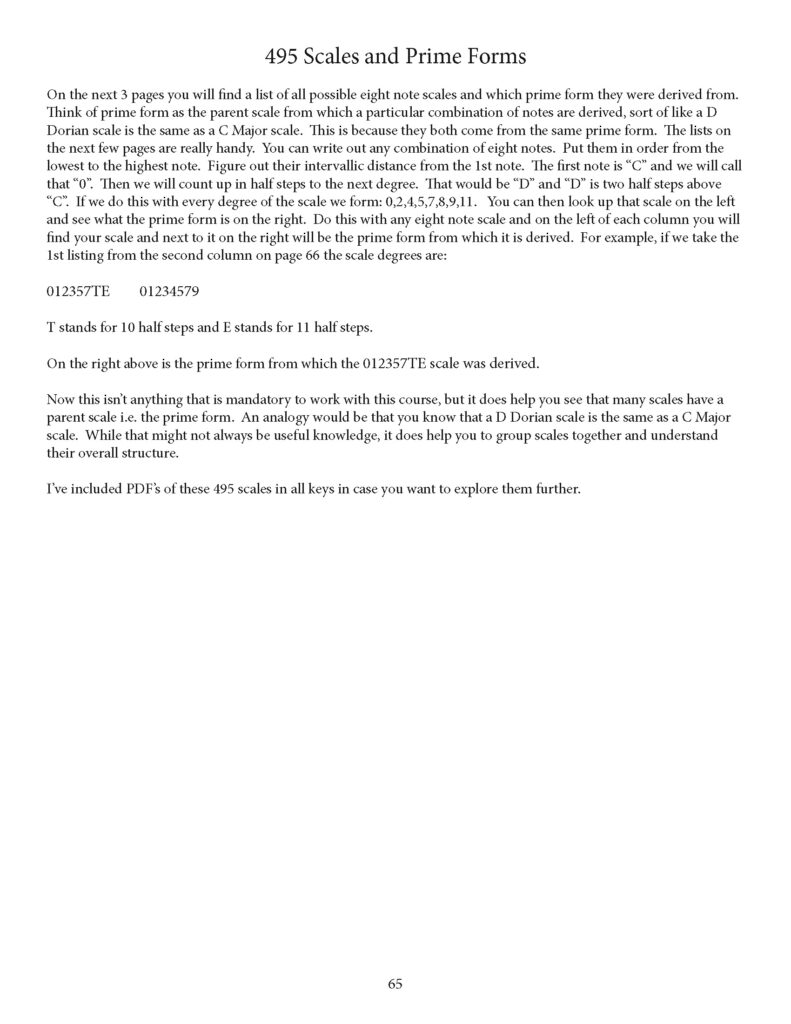
495 Eight Note Scales in all 12 keys

495 Eight Note Scales in all 12 keys

Guitarist Bruce Arnold BLOG Logo jazz guitar Two Triad Pairs found in The Harmonic and Melodic Equivalence Series  

495 Eight Note Scales in all 12 keys

Bruce Arnold’s “495 Eight Note Scales in all 12 keys” course covers the 495 possible eight note scales and gives you that information in all 12 keys.  This is pretty unheard of as far as a published lexicon of eight note scales.  While most musicians are familiar with the common octatonic scales of diminished many times they overlook a few facts about eight note scales.

First, I think the most important thing to realize you can take any scale that is commonly used over a dominant chord and add one more note to this scale.  This added note would be one of the 6 available tensions.  There are a few common examples of this like using this scale as a replacement for a G7 chord: G,Ab,Bb,B,C,D,Eb,F which is like a G mixolydian b2,b6 scale with an added Bb.  There are tons of other possibilities which are all covered in this course.

To get into the specifics “495 Eight Note Scales in all 12 keys” looks at of course the 495 octatonic scales but also includes their internal structure, which chords they can be played over and much more information to help you organize your study. The interesting this is that all of these 495 possible eight note scales can be reduced down the 29 prime forms using pitch class set theory that can be helpful when you are organizing how these octatonic scales interrelate but also help in their memorization.

In the 495 Eight Note Scales in all 12 keys I’ve also include references to these prime forms throughout the course. The pitch class set theory information is by no means crucial to working with this course but over time I’m sure you will see its usefulness. I’ve written another book called “Sonic Resource Guide.” if you want to learn more about pitch class set theory and how it can be used by an improvising musician.

Since most musicians aren’t aware of the use of octatonic scales I’ve Included in the “495 Eight Note Scales in all 12 keys” course a list of compositions by various composers who have used octatonic scales. I think it’s important to listen to some of this music to give you ideas and inspiration. I would also recommend you check out the music and improvisations of guitarist Alan Holdsworth. Mr. Holdsworth’s use of octatonic scales in his compositions and improvisations is one of the reasons his music sounds so different.

“495 Eight Note Scales in all 12 keys” also contains a list of the two tetrad (4 note) chords that form the complete eight note scale. This is a highly useful list that shows the Two Tetrad combinations for the 29 possible pitch class sets. This list again comes from the “Sonic Resource Guide” which I mentioned earlier.  The Two Tetrad list is a great technique for finding two chords that can be used to make up a octatonic scale but also is a great improvisational technique in itself which I highly recommend.

You can purchase this course in a few ways. 

Purchase at Muse Eek Publishing Inc.495 Eight Note Scales in all 12 keys

Purchase at Bruce Arnold’s Patreon Site

495 Eight Note Scales in all 12 keys


Below is a list of the table of contents from the “495 Eight Note Scales in all 12 keys”course


Table of Contents:

Composers and Musicians that have used Octatonic Scales 495 Eight Note Scales How to Work with this Course “Derivative” Composition Chords and Available Tensions Ways to Implement Diatonic Octatonic Chords 495 Eight Note Scales with Prime Form Diatonic Chords of Eight Note Scales Diatonic Chords of the Key of C Conclusion


List of Contents for 495 Eight Note Scales Course:

 
24 Page PDF
 
“Octatonics Prime Form, Degrees, Forte Number, Chord Application” PDF 260 pages
 
495 Scales with All 12 Chromatic Modes
 
All 495 Eight Note Scales in all keys 372 Pages of PDFs with Midi Files
 
All 495 Eight Note Scales in all Keys Ascending-Descending 744 Pages of PDFs with Midi Files
 
29 Two Tetrad Combinations 29 Eight Note Prime Forms 29 Page PDF
 
Three Tetrad Combinations Page 30-58 of above PDF.
Jam Tracks V1 (MP3’s of 10 chord types in all 12 keys) ISBN: 978-1-59489-292-9

Bruce Arnold Music Education Genealogy Chart

You might enjoy checking out the “Music Education Genealogy Chart” located on my artist’s site. You will clearly see the historic progression of pedagogy that is the basis for Muse Eek Publishing Products. Great musicians throughout history have been studying the ideas presented by Muse-eek.com which derives its content from a a lineage that stretches back to Scarlatti!

495 Eight Note Scales in all 12 keys a book by Bruce Arnold
Bruce Arnold photo by Bernard Levy

Bebop Scales 124 Bebop Scales and Their Application

Bebop-Scales-124-and-Their-Application
Bebop Scales 124 Bebop Scales and Their Application

This book by Bruce Arnold titled “Bebop Scales 124 Bebop Scales and Their Application” delves into an extensive exploration of various Bebop scales and their practical use in musical contexts. Within this comprehensive resource, readers can expect to find in-depth explanations of 124 distinct Bebop scales, along with detailed insights into how these scales can be effectively applied in musical compositions and jazz improvisation.

By meticulously examining each scale and its unique characteristics, this book equips musicians with a valuable toolkit for enhancing their understanding and utilization of Bebop scales in their musical endeavors. With a focus on both theoretical knowledge and practical application, “Bebop Scales 124 Bebop Scales and Their Application” serves as a valuable reference for musicians seeking to expand their repertoire and deepen their grasp of Jazz theory. Through its systematic approach and detailed analysis, this document offers a comprehensive guide to mastering Bebop scales and leveraging their full potential in musical performance and composition.

Bebop scales are some of the most commonly known octatonic scales and are one of the techniques used by jazz musician to create a “Bebop Sound.” They are used in a very specific way so they are in a special class of eight note scales. Most musicians are familiar with a small subset of Bebop scales used in jazz improvisation.

This course looks at the common Bebop scales as well as many more. You can see from the Table of Contents below that many aspects of Bebop scales are covered as well as an introduction to some of the other courses which cover; Segmenting Bebop scales on Muse Eek Publishing website or Segmenting Bebop Scales on Patreon and Segmenting Bebop scales with Approaches on Muse Eek Publishing Website or Segmenting Bebop Scales with Approaches on Patreon.

You would see by checking out these three courses that you get an in-depth study of Bebop Scales which goes way beyond most books on the subject.  Theses three courses mentioned above will really help you to grasp the full potential of Bebop Scales. Overall “Bebop Scales 124 Bebop Scales and Their Application” is a great place to start learning Bebop Scales, understanding their use and seeing future ways that you can practice and apply them.  

Table of Contents:

Bebop Scales

Common Bebop Scales

Course Breakdown

29 Octatonic Scales

Seventh Chords Continued

124 Bebop Scales Chromatic Modes of Bebop Scales

Bebop Scales and Chords They Work Over

Going Beyond Bebop Scales

Diatonic Chords of Eight Note Scales; an introduction

Chord Tones and Available Tensions

Passing Diminished

Chords Derived from an Eight Note Scale; an introduction

Application of Eight Note Scales; an introduction

As you can see from the TOC this course explores Bebop Scales on a very deep level.  It also includes references to Pitch Class Set Theory so that you can see how all scales are related back to the 29 Eight Note Scale Prime Forms.

Bruce Arnold’s new book called Bebop Scales 124 Bebop Scales and Their Application is for sale at Muse Eek Publishing Inc. website or at Bruce Arnold’s Patreon site.   There are links below to these sites:


Bebop Scales book on Muse Eek Publishing WebsiteBebop-Scales-124-and-Their-Application

Bebop Scales book on Patreon SiteBebop-Scales-124-and-Their-Application

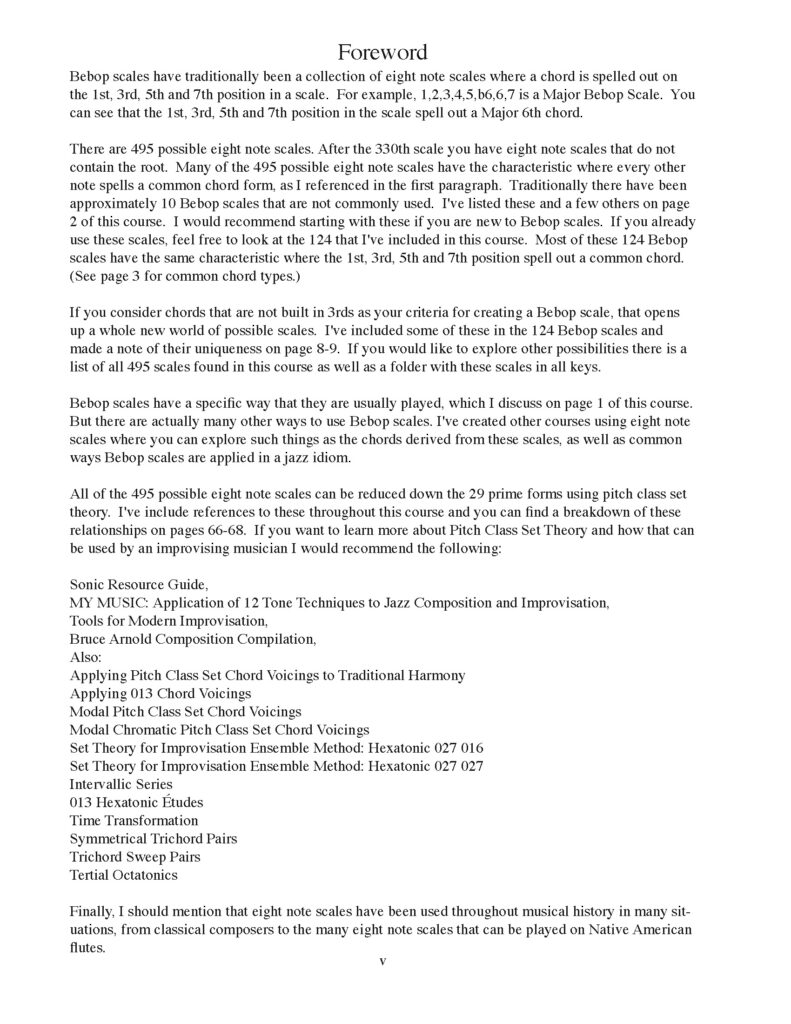
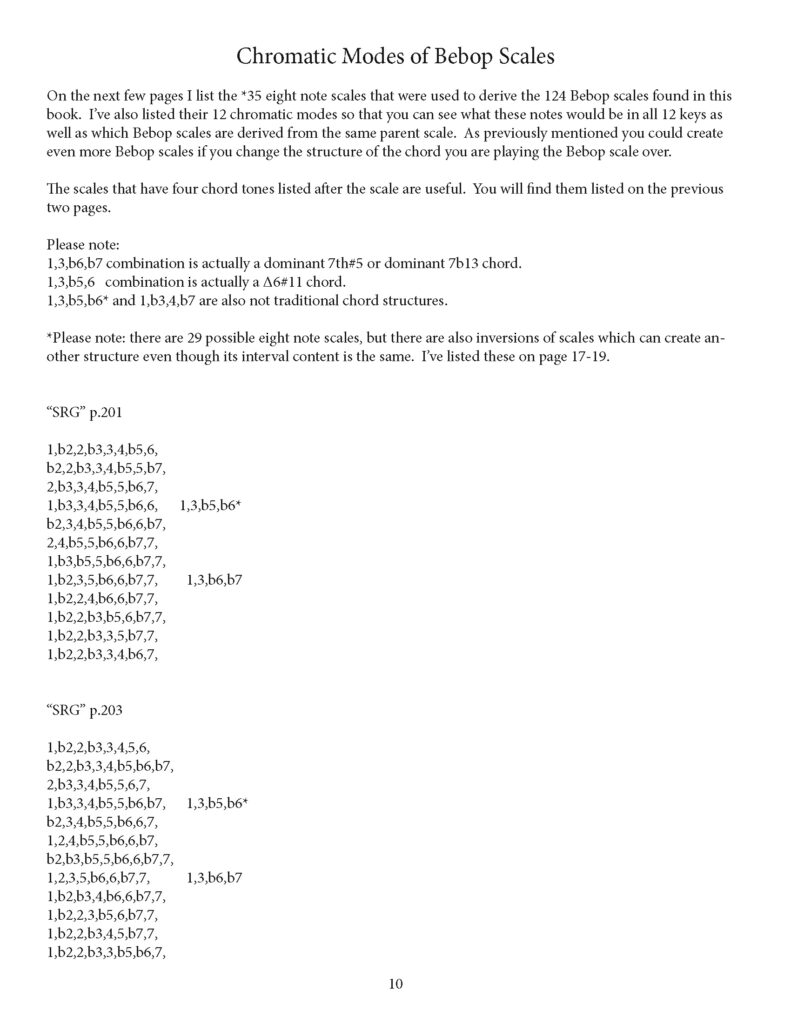
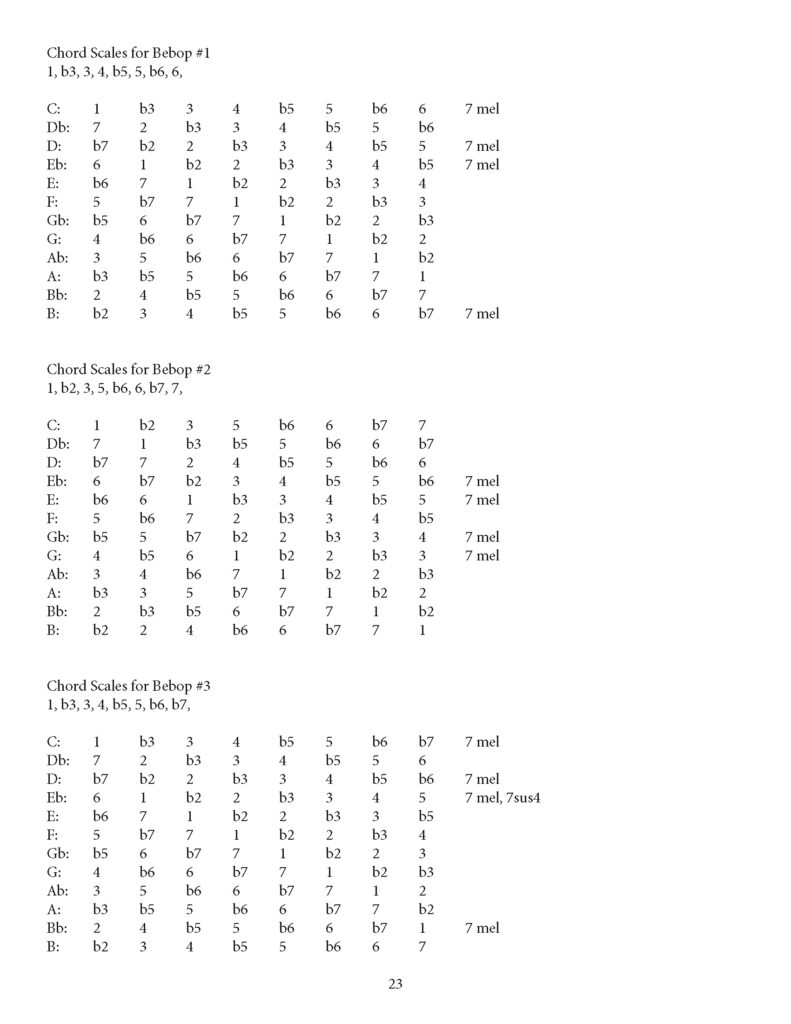
Below are some excerpts from the “Bebop Scales 124 Bebop scales and Their Application.”  Again, Bruce Arnold gives you an overview of the three courses that make up the thorough examination of Bebop scales and beyond.


Forward page from Bebop Scales 124 Bebop Scales and Their Application

Bebop Scales 124 Bebop Scales and Their Application

Chromatic Modes of a Bebop Scale Example

Bebop Scales 124 Bebop Scales and Their Application Chromatic Modes
Chromatic Modes of a Bebop Scale Example


Chords that Bebop Scales Work Over Example

Bebop Scales 124 Bebop Scales and Their Application  Chords that Bebop Scales Work Over Example


495 Bebop Scale List Excerpt

Bebop Scales 124 Bebop Scales and Their Application 495 Bebop Scale List excerpt from the book Bebop Scales: 124 Bebop Scales and Their Application

Bruce Arnold Music Education Genealogy Chart

You might enjoy checking out the “Music Education Genealogy Chart” located on my artist’s site. You will clearly see the historic progression of pedagogy that is the basis for Muse Eek Publishing Products. Great musicians throughout history have been studying the ideas presented by Muse-eek.com which derives its content from a a lineage that stretches back to Scarlatti!
 

Bebop Scales: 124 Bebop Scales and Their Application by Bruce Arnold
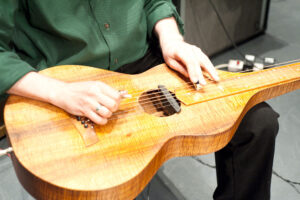
Bruce Arnold Playing a Rayco Resophonic Lab Slide Guitar

Two Triad Pairs

Guitarist Bruce Arnold BLOG Logo jazz guitar Two Triad Pairs found in The Harmonic and Melodic Equivalence Series

Two Triad Pairs found in The Harmonic and Melodic Equivalence Series

If you look in the Sonic Resource Guide you will find that there is 50 possible hexatonic scales and 10 possible three note pairs for any hexatonic scale.  So now you see why there are 500 possible combinations.   Think of the 10 possible three note pairs for any hexatonic scale as a blueprint for the different types of melodies and chords that you can create using this two pair principle. 

Here’s an Analogy

To give you an analogy learning only a single two 3 note combination for a common scale would be like learning a C major scale but only playing it C,D,E,F,G,A,B and never any of the other possible combinations like C,E,G,F,A,C,B.  Obviously you are missing out on a whole world of other melodic ideas not to mention the cool chords that you get from the non-tertial combinations.  Of course I also haven’t even mentioned the awesome harmonic progressions that certain two three note pairs create.   I hope that helps you understand why each of these combinations is important and gives you more ideas on how to use them in your compositions and improvisations.

Bruce-Arnold-Guitar-Two Triad Pairs found in The Harmonic and Melodic Equivalence Series

Bruce Arnold Music Education Genealogy Chart

You might enjoy checking out the “Music Education Genealogy Chart” located on my artist’s site. You will clearly see the historic progression of pedagogy that is the basis for Muse Eek Publishing Products. Great musicians throughout history have been studying the ideas presented by Muse-eek.com which derives its content from a a lineage that stretches back to Scarlatti!

I thought I’d do a post giving a better idea on how many two triad pairs are found in the The Harmonic and Melodic Equivalence Series and why I’ve given more than one 2 triad pair for any traditional scale.

How many books are going to be in this Harmonic and Melodic Equivalence Series

First, if I was to do all possible two triad pair combinations there would be 500 books in the The Harmonic and Melodic Equivalence Series.  I’m not doing anything close to that number.  Here is a break down of the books I’m doing.

  • 1. All two triad combinations based on tertial possibilities which is 32 combinations.
  • 2  All symmetrical combinations of non-tertial two three note pair of which would be approximately 24 books.
  • 3. Finally I’m doing books that explore the non-tertial non-symmetrical combinations that I have found useful.  There will be approximately 10 books in that series.

If you look in the Sonic Resource Guide you will find that there is 50 possible hexatonic scales and 10 possible three note pairs for any hexatonic scale.  So now you see why there are 500 possible combinations.   Think of the 10 possible three note pairs for any hexatonic scale as a blueprint for the different types of melodies and chords that you can create using this two pair principle. 

Here’s an Analogy

To give you an analogy learning only a single two 3 note combination for a common scale would be like learning a C major scale but only playing it C,D,E,F,G,A,B and never any of the other possible combinations like C,E,G,F,A,C,B.  Obviously you are missing out on a whole world of other melodic ideas not to mention the cool chords that you get from the non-tertial combinations.  Of course I also haven’t even mentioned the awesome harmonic progressions that certain two three note pairs create.   I hope that helps you understand why each of these combinations is important and gives you more ideas on how to use them in your compositions and improvisations.

Bruce-Arnold-Guitar-Two Triad Pairs found in The Harmonic and Melodic Equivalence Series

Bruce Arnold Music Education Genealogy Chart

You might enjoy checking out the “Music Education Genealogy Chart” located on my artist’s site. You will clearly see the historic progression of pedagogy that is the basis for Muse Eek Publishing Products. Great musicians throughout history have been studying the ideas presented by Muse-eek.com which derives its content from a a lineage that stretches back to Scarlatti!
The Harmonic and Melodic Equivalence Series

Guitarist Bruce Arnold BLOG Logo jazz guitar The Harmonic and Melodic Equivalence Series

The Harmonic and Melodic Equivalence Series

The Harmonic and Melodic Equivalence Series contains over 40 courses that explore three note pairs. These three note pairs form a hexatonic scale and can be used to make interesting melodies as well as being great 3 note chords. Two different types of three note pairs are explored in these courses. Tertial pairs are constructed with Major, Minor, Diminished and Augmented triads while the non-tertial pairs are constructed using various combinations of the 12 possible three note structures those are:

  • 012
  • 013
  • 014
  • 015
  • 016
  • 024
  • 025
  • 026
  • 027
  • 036 which is a diminished triad.
  • 037 which is a major or minor triad.
  • 048 which is an augmented triad.

This blog post will look at two important courses from the Harmonic and Melodic Equivalence Series. These are Volumes Seven and Eight which look at combining two 016s. The 016 is one of the most important three note combinations in music. This pitch class set has a tritone within its structure which is the backbone of dominant chords, and one of the most used intervals in music. The Harmonic and Melodic Equivalence Series looks at the possible applications of a single 016 as well as two 016s played together to form a hexatonic scale.

Exploring Two of the Courses from the Harmonic and Melodic Equivalence Series

As I just mentioned, the Harmonic and Melodic Equivalence Series has two courses that explore two 016-016 three note pairs. But that really is just the tip of a massive iceberg of sound. Let’s look at one of the most used scales in improvisation, the symmetrical diminished scale (1, b2, b3, 3, #4, 5, 6, b7). There are eight 016s found in this scale and 12 016-016 combinations:

  • [C Db Gb] [A E Eb] 0 1 6 0 1 6
  • [C Db Gb] [Bb E Eb] 0 1 6 0 1 6
  • [C Db Gb] [A Bb Eb] 0 1 6 0 1 6
  • [C Db Gb] [A Bb E] 0 1 6 0 1 6
  • [C Db G] [A E Eb] 0 1 6 0 1 6
  • [C Db G] [Bb E Eb] 0 1 6 0 1 6
  • [C Db G] [A Bb Eb] 0 1 6 0 1 6
  • [C Db G] [A Bb E] 0 1 6 0 1 6
  • [C G Gb] [A E Eb] 0 1 6 0 1 6
  • [C G Gb] [Bb E Eb] 0 1 6 0 1 6
  • [C G Gb] [A Bb Eb] 0 1 6 0 1 6
  • [C G Gb] [A Bb E] 0 1 6 0 1 6

That’s a lifetime of work right there –just to master all these combinations in all keys. The good news is, once your learn one 016-016 combination it is much easier to master the next because of the built-in symmetry of the structure.

The Nature of a Dominant Sound

One of the reasons I say that this 016-016 combination is a lifetime of work is because of the nature of a dominant sound. If you explore the reharmonization principles presented in Chord Workbook for Guitar Volume One you will see that there are 3 ways a dominant chord can resolve so in a way that triples the list above because remember, you want to think of all these relationships in the overall key center of the moment. Then if you look at the reharmonization principle presented in Chord Workbook for Guitar Volume Two which presents the idea of using reharmonizing chords based combining chord tones and tensions you exponentially increase the size of the list of possibilities. Overwhelming? Yes, but I find it more exciting that I can learn one combination on my instrument and have a plethora of applications for that one combination. And that makes practicing 016 very rewarding because by learning one thing you find multiple uses that will mushroom your sound palette.

Finding the Important Two Three Note Combinations

The Harmonic and Melodic Equivalence Series does not cover all the three note pairs that are found in music, but it does cover the combinations that I’ve found the most useful. It explores the common triadic combinations that most people have discussed in other books, but more importantly, it looks at the non-triadic combinations that have been very neglected, which is crazy because these sounds not only work wonderfully as melodic lines, but also create awesome chordal sounds. In the case of the 016 as both a melodic and chordal sound it’s a sound you are used to hearing. The common drop two C13 chord C, Bb, E, A has an 016 in its top three notes so many musicians are already using 016 –they just don’t realize it!

By exploring the 016 and all the books in the The Harmonic and Melodic Equivalence Series you will open up a whole new world of fresh sounds and a new way to look at things you commonly play. It all cases it will expand your knowledge and make you a better musician by showing you new ways to perceive and work with music.

Need Help Understanding what an 016 is?

I’ve written a book called the Sonic Resource Guide which explains pitch class set theory in very easy to understand terms. Think of pitch class set theory as a way to organize all possible scales (of which there are 220.) Using this method you can really wrap your head around all melodic and harmonic possibilities in music. Check in out it will change your whole musical life!

Bruce-Arnold-Guitar-The Harmonic and Melodic Equivalence Series

Bruce Arnold Music Education Genealogy Chart

You might enjoy checking out the “Music Education Genealogy Chart” located on my artist’s site. You will clearly see the historic progression of pedagogy that is the basis for Muse Eek Publishing Products. Great musicians throughout history have been studying the ideas presented by Muse-eek.com which derives its content from a a lineage that stretches back to Scarlatti!
Harmonic and Melodic Equivalence

Harmonic and Melodic Equivalence

Harmonic and Melodic Equivalence

Harmonic and Melodic Equivalence

The Harmonic and Melodic Equivalence Series looks at the twelve possible groupings of 3 notes in various configurations. Most volumes concentrate on symmetrical pairs such as two 027’s, but there are exceptions, such as where interesting combinations the 016-027 combination for a blues scale are explored. Overall, this series as presents alternate melodic and harmonic ideas that can be substituted for the regular scales or melodies that you use in common musical situations. It’s sure to open you up to some unique sounds and put a modern spin on your improvisation.

There are many ways you could approach playing the exercises in these books, and I’d like to present some ideas that I’ve used over the years to master the exercises –and more importantly, get these sounds into my playing. Here is a list of the general categories that I’ve explored when practicing these exercises.:

  • Singing
  • Segmenting the exercise into single measure of octave displacement
  • Adding Embellishments
  • Sight Reading
  • Memorization
  • Sound Production
  • For Stringed Instruments:
  • 1. Use String Sets
  • 2. Tremolo picking
  • 3. Fingering choices
  • 4. Other techniques

Singing:

I put singing first because getting these melodies deep into your musical memory and making sure you actually hear how each note is functioning within the key center is crucial to making real music with these melodies. I would take at least one exercise a day (usually 12 measures) and sing through it over a drone. Singing these exercises in time would be the ultimate goal but at least get started by singing them over a MetroDrone® out of time to get you hearing each melody.

Segmenting the exercise:

I think it’s a great start to just read through each exercise in full, to find physical barriers that need adjustment within your technique. At the same time, I would also recommend taking smaller segments and applying them to real music. I often use a single measure, and look at different ways to apply this idea to multiple musical situations. In general, it is better to work on fewer exercises and spend time applying the insights you get from them to real music.

It is also a good idea to take parts of the exercise and try to play and apply these melodic fragments in different octaves on your instrument.

Adding Embellishments:

Adding embellishments to each melody or fragment is crucial to making it sound like music. All great melodies have embellishments so think about adding these to each example:

  • Slides
  • Bends
  • Accents
  • Different dynamic levels
  • For Stringed Instruments:
  • Hammer-ons
  • Pull-offs
  • Tapping

Sight Reading:

These books are great for sight reading. Each course presents a different challenge both physically and mentally. Some of these melodies can be very angular or use unusual melodic shapes; therefore they are great for developing your sight reading skills.

Memorization:

I would use smaller melodic fragments, like a measure, and memorize this sound so you can get your eye and mind away from the printed page. Once memorized, start applying this fragment to real music

Sound Production:

These exercises are great for developing a “sound” on your instrument. When working on this aspect try to keep the following in mind:

  • Play each note at the same dynamic level
  • Try to give each note a beautiful sound (timbre, texture, etc) and have that sound consistent through the rest of the notes
  • Accents
  • Have each note be the same length in time
  • For Stringed Instruments:
  • Make sure you connecting each note as seamlessly as possible so that you have a legato —but precise–sound

For Stringed Instruments:

There are some specific characteristics that a stringed instrument possesses that will facilitate the playing of each exercise, and help broaden the ways you can express each idea. Here are some suggestions for playing each exercise

  • Use string sets to play linearly up and down the neck
  • Try tremolo picking to develop picking technique
  • Look at different ways to finger each exercise or segment
  • Explore other techniques such as different bowing, tapping or other extended techniques specific to your instrument

Final Considerations

You don’t have to make the Harmonic and Melodic Equivalence Series your sole practice tool. I would just take a few of these ideas and spend a few minutes each day with them to develop the areas where you are the weakest. That said, if you want incredible musical technique, this series of books is excellent for developing amazing chops on your instrument… which of course will require hours of practice each day.

Harmonic and Melodic Equivalence

Bruce Arnold Music Education Genealogy Chart

You might enjoy checking out the “Music Education Genealogy Chart” located on my artist’s site. You will clearly see the historic progression of pedagogy that is the basis for Muse Eek Publishing Products. Great musicians throughout history have been studying the ideas presented by Muse-eek.com which derives its content from a a lineage that stretches back to Scarlatti!
Practicing Music in the Time of Covid-19

Guitarist Bruce Arnold BLOG Logo jazz guitar Practicing Music in the Time of Covid-19

Practicing Music in the Time of Covid-19

Practicing Music in the Time of Covid-19

Practicing music in the time of Covid-19 is challenging, to say the least. I’ve spoken with many of you via email and Skype lessons over the past few weeks and it is painfully apparent that musicians are struggling in so many ways during this time. I’ll be sending out some emails to give moral support and some suggestions on how to get through this tough time and still improve your musicianship.

One of the first things to understand is that when you are upset, your body tends to release chemical reactions to make you not remember. So if you are finding it hard to remember, that is normal. Of course remembering is fundamental to improving your musical ability — so how do you work around this?

If you are finding this to be true and you are cutting back on practicing because it seems fruitless, then try these things:

  • Switch from mentally difficult things and spend more time just playing music. Concentrate not on the stuff you don’t know, but on the stuff you do know, and try to make that a little better, which it will, because you are concentrating on it.
  • Improvise, Improvise, Improvise… Take some of the Jam Tracks and just improvise over the tracks. Don’t judge what you are doing just play and let the music heal you for a few minutes each day.
  • Don’t beat yourself up about not improving. Now is not the time for that. Now is the time to remember how much you love music and how it makes you feel.
  • If practicing is just not happening then listen to music. I find that to be a major weak point with many musicians. They just don’t listen to music. Make this a time where you pull out your old favorites or get into something new.

Finally, stay in touch. I’m here to help. If you are having issues let me know. I’ve been around the block a few times and have learned a lot about music and practicing. I can probably help you through this time– and I would be happy to.

Bruce-Arnold-Guitar-Practicing Music in the Time of Covid-19

Bruce Arnold Music Education Genealogy Chart

You might enjoy checking out the “Music Education Genealogy Chart” located on my artist’s site. You will clearly see the historic progression of pedagogy that is the basis for Muse Eek Publishing Products. Great musicians throughout history have been studying the ideas presented by Muse-eek.com which derives its content from a a lineage that stretches back to Scarlatti!
Pitch Class Set Theory and Practice Courses

Guitarist Bruce Arnold BLOG Logo Pitch Class Set Improvisation Bruce-Arnold-Guitar-Flutterby-18 sight reading recommendation Applying Rhythm Ideas Cycle 5 Bruce-Arnold-Guitar-Flutterby-25 Guitarist Bruce Arnold BLOG Logo jazz guitar Bruce-Arnold-Guitar-Flutterby-24 Guitarist Bruce Arnold BLOG Logo music education Guitar Intensive Workshop Guitarist Bruce Arnold BLOG Logo music education ear training course ear training Ear Training For Young People Chord Spellings New Muse-eek.com website Bruce-Arnold-Guitar-Flutterby-24 Guitarist Bruce Arnold BLOG Logo music education Guitar Intensive Workshop Ear Training Encouragement Ear Training Guided Tour Bruce-Arnold-Guitar-Flutterby-16 Modern Reharmonization Approach Notes Practice Jam Tracks Bundle Course Five Backing Track Courses One Minute Lessons Technique One Minute Lessons Phrasing Bruce-Arnold-Guitar-Flutterby-10 Minor Key Ear Training Applying Pitch Class Set Course Bruce-Arnold-Guitar-Flutterby-Cycle 5 Importance of Modal Sequencing Pitch Class Set Theory and Practice Courses

Pitch Class Set Theory and Practice Courses

Pitch Class Set Theory and Practice Courses

Here’s what’s covered in the Pitch Class Set Theory and Practice Courses.  The three courses combine étude-like exercises with a theory section explaining how these études were created.   That is what sets them apart from the Pitch Class Set Improvisation Études Courses which basically just give you études without any theory attached.

Organizing Pitches in New Ways

One of the main ingredients of pitch class set improvisation is organizing pitches in new ways to create a unique sounding melodic line.  The three courses (described below) within the Pitch Class Set Theory and Practice Course Bundle do this by either combining a hexatonic scale (6 notes) into two groups of three notes and pivoting back and forth between these two groups or using an octatonic scale (8 notes) and pivoting back and forth between two groups of four notes.

Historic Background of Pitch Class Set Theory and Practice Courses

Pivoting back and forth between two groups of three notes was one of McCoy Tyner’s favorite melodic tools, and he used it for improvisation as well as composition.  If you check out “Passion Dance” in the Real Book you will see McCoy pivoting back and forth between two major triads a whole step apart.  This creates a great sound and can be done with any two groups of three notes whether they are tertial triads or not.

Three Courses in the Pitch Class Set Theory and Practice Course Bundle

Symmetrical Trichord Pairs looks at all the combinations of two groups of three notes that are identical in their structure.  For a student learning this new way of improvising, having two symmetrical groups of three notes makes it easier to physically get these ideas under your fingers but also makes it easier to remember these combinations because both group of notes are identical in structure.

Trichord Sweep Pairs looks at all possible combinations of two three note groups and make these combinations into a six note arpeggio.  These six note arpeggios or sweeps as guitarists usually call them create very intriguing sounds.  For guitarists, these six note arpeggios can be played very fast because you are basically just strumming across six strings which can be played very quickly.  In order to properly develop this sweep technique I would recommend guitarists also take a look at the Guitar Technique and Physiology course to make sure they are developing the proper way to do this.

The last is the Tertial Octatonics Course which looks at all the eight note scales that can be created with two 7th chords.  This is a really great course because if you already know how to play 7th chords you can quickly put two of them together to create a very cool sound.  The book again gives you the theory behind each combination and the chord types that you can superimpose this sound over.

All three of these courses found in the Pitch Class Set Theory and Practice Course Bundle really give you some unique ways of combining three and four note groups of notes to create some new sounding melodic lines.  I personally like these courses because they allow me to be very compositional in my playing over any piece of music.  What I do, is look at the interval content of the melody of a song and then use that interval content to solo with the ideas presented in all of the books in the Pitch Class Set Improvisation Courses.

Making Your Improvisation Relate More to a Composition

You could think of this approach as playing off a melody of a piece of music, but on steroids.  You can do this both melodically and harmonically which can really take a piece of music to a very interesting place.  Just a quick example.  If you took the Jazz Standard “Stella By Starlight” and analyze the melody you would find that it is made up of mostly half steps and minor third movements.  That is an 013 in pitch class set theory.  Playing all the chords as 013’s really creates a very modern sounding version of this tune.

But you can do this with any style from Heavy Metal to Classical to Jazz! It works great and is one of the major reasons I got so involved in this Pitch Class Set Improvisation idea in the first place.

Bruce-Arnold-Guitar-Flutterby-Cycle 5 Importance of Modal Sequencing Pitch Class Set Theory and Practice Courses

Bruce Arnold Music Education Genealogy Chart

You might enjoy checking out the “Music Education Genealogy Chart” located on my artist’s site. You will clearly see the historic progression of pedagogy that is the basis for Muse Eek Publishing Products. Great musicians throughout history have been studying the ideas presented by Muse-eek.com which derives its content from a a lineage that stretches back to Scarlatti!
Charlie Banacos Mushrooms Concept

Guitarist Bruce Arnold BLOG Logo jazz guitar Bruce-Arnold-Guitar-Flutterby-24 Guitarist Bruce Arnold BLOG Logo music education Guitar Intensive Workshop The Music Rhythm Series Time Transformation Music Rhythm Series Course Asher Electro Hawaiian Slide New York Guitar Method Bundle One Minute Lessons Harmony Bruce-Arnold-Guitar-Flutterby-11 Pitch Class Set Chord Voicings Two and Three Note Modal Sequencing Common Building Blocks of Melodies Études to teach music Bruce-Arnold-Guitar-Flutterby-10 Minor Key Ear Training Applying Pitch Class Set Course Charlie Banacos Mushrooms Concept

Charlie Banacos Mushrooms Concept

Charlie Banacos Mushrooms Concept

I studied with the inspiring music guru Charlie Banacos for 5 intense years. He introduced me to so many concepts of improvisation and composition, I could easily spend many lifetimes working on all of it. Because I wanted to pass along his teaching legacy, many of his concepts have been included in my books in way or another.     Charlie called one of his approaches “Mushrooms” and they became part of many courses that are now available on the muse-eek.com website.  The overall idea of Charlie Banacos Mushrooms Concept is to take any group of notes and figure out everywhere that you could play those notes as a melodic line or a harmony.  This concept will “Mushroom” your playing because anything you learn can be used in a multitude of ways. Let’s take as an example the notes of a C Major 7 chord C, E, G, and B.  Then let’s look at some of the places where you could use those notes.  In order to do this we have to know the possible chord tones and tensions that are available for any chord type.    

Chord Tones and Available Tensions

From looking at the information in these books you would find for instance that a dominant chord can have:

  • Chord Tones: 1,3,5,b7
  • Tensions: b2, 2, b3, b5, b6, and 6

Charlie Banacos Mushrooms Concept appears in many courses on the muse-eek.com website here are some of those courses:

Applying Charlie Banacos Mushrooms Concept

Let’s now look at some possible places where C, E, G, and B would work as a chord replacement or for that matter a melodic line.  Playing the C, E, G, and B over the following chords would work because those four notes are either chord tones or available tensions on the following 7th chords:

  • D7
  • Eb7
  • Bb7
  • A7

There would be more possibilities if we included avoid notes in our calculations but believe me the list is large enough without this information.  Charlie would add one more step to the “Mushrooms.”  You then add in Approach Notes to the new superimposed notes.  You will find a detailed explanation of this in the Approach Note Course.  

An Easy Way to Apply Charlie Banacos Mushrooms Concept

Coming up with a list of every chord that C, E, G, and B will work over is time consuming and it’s easy to miss some relationships.  To solve this I created the Sonic Resource Guide which lists every possible combination of two to eleven notes and which chord each of those pitch class sets can be used over.  That list is something I access daily (although I pretty much have it memorized at this point) as I work with various note combinations. But think of the Sonic Resource Guide as Charlie Banacos Mushrooms Concept on steroids.

The Sonic Resource Guide is part of the Pitch Class Theory Course Bundle which also comes with the Tools for Modern Improvisation and the Bruce Arnold Composition Companion.  So think of the Sonic Resource Guide as your reference book for every combination of notes and the Tools for Modern Improvisation as a book that shows you some common uses of many improvisational techniques derived from the Sonic Resource Guide. Finally, the Composition Companion shows you examples of real music using these ideas.

Conclusion

Hopefully you can see the powerful uses of a book like Sonic Resource Guide because through the listing of every possible way to combine a group of notes within a octave you can easily take any group of notes and look up all its relationships.  This is why I recommend that all students have the Sonic Resource Guide.  It is the key to finding all the relationships such as the Charlie Banacos Mushrooms Concept and many others.

Bruce-Arnold-Guitar-Flutterby-10 Minor Key Ear Training Applying Pitch Class Set Course Charlie Banacos Mushrooms Concept

Bruce Arnold Music Education Genealogy Chart

You might enjoy checking out the “Music Education Genealogy Chart” located on my artist’s site. You will clearly see the historic progression of pedagogy that is the basis for Muse Eek Publishing Products. Great musicians throughout history have been studying the ideas presented by Muse-eek.com which derives its content from a a lineage that stretches back to Scarlatti!